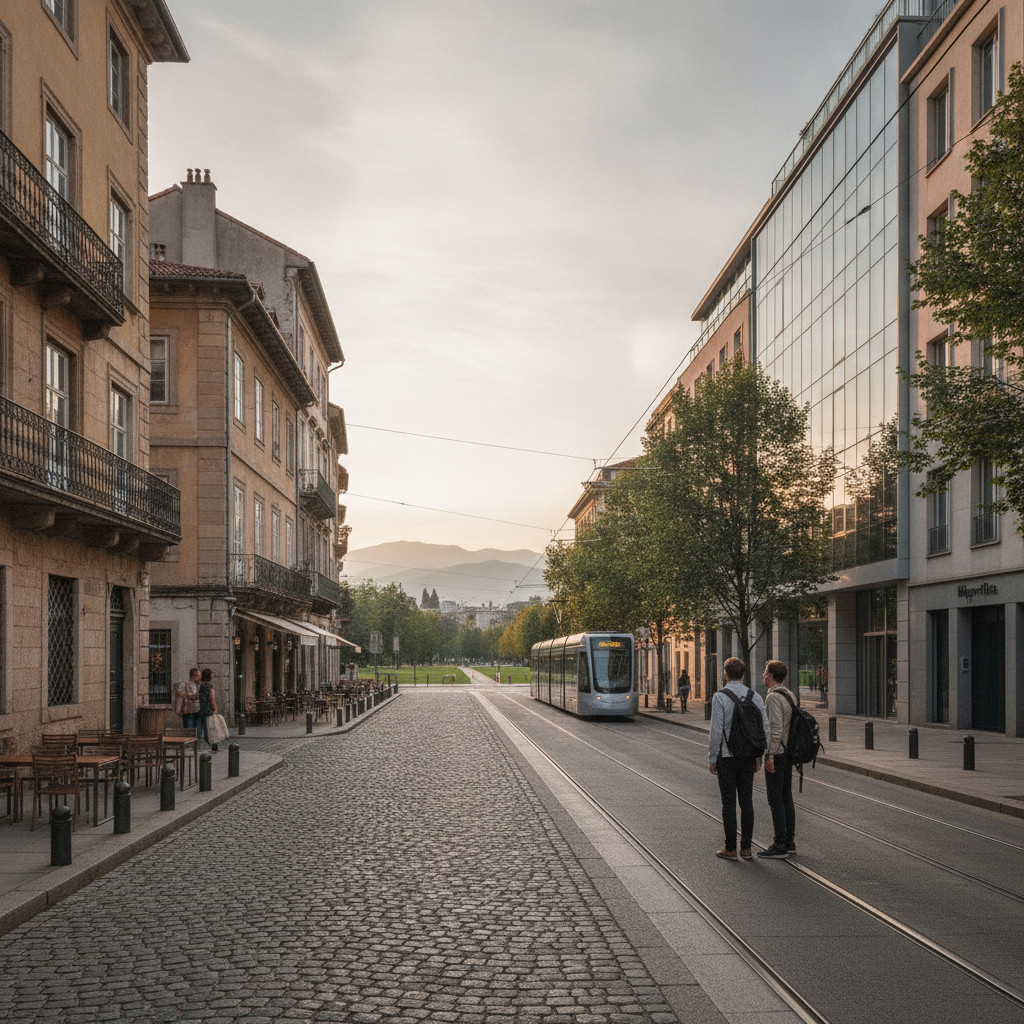
The way a traveler chooses to position themselves within a city shapes everything that follows — not just the commute to landmarks, but the texture of daily life, the faces encountered over morning coffee, and the quiet rhythms that never appear in any guidebook. Most travelers default to the center, drawn by the logic of convenience and the reassurance of proximity to the well-reviewed and well-mapped. But there is a different kind of intelligence in choosing the periphery, the soft border where one neighborhood gives way to another, where the polished fades into the lived-in, and where the experience of a place becomes genuinely personal rather than collectively curated.
The Threshold Between Worlds
In urban geography, this border zone carries a name: the *transition zone*, or what sociologists sometimes call an *interstitial space* — the in-between area that doesn't fully belong to either the commercial core or the purely residential. For travelers, this liminal quality is less an inconvenience than an invitation. A hotel or guesthouse positioned at the edge of, say, Barcelona's El Born district or Lisbon's Mouraria quarter places the traveler at exactly the kind of seam where neighborhoods negotiate their identities. The streets become more varied, the foot traffic less uniform, and the businesses tend to serve residents rather than visitors — which means the food is priced honestly, the produce markets open early, and the café owner has time for a real conversation. There is no performance of local life at the margins; it simply exists, and the traveler is allowed to witness it without an interpretive layer between them and the street.
This positioning also tends to reframe the physical act of moving through a city. When the accommodation sits at a neighborhood's edge, every outing becomes directional in a meaningful way — walking toward the center means moving into density and spectacle, while walking away from it leads somewhere quieter and less scripted. The traveler develops an intuitive mental map that extends in multiple directions rather than radiating outward from a single tourist node. Cities like Kyoto reward this approach particularly well: staying near the edge of Gion rather than in its photographed heart means waking to streets that belong to residents before they belong to visitors, and that timing changes everything about how the place is received.
What the Center Costs Beyond the Room Rate
The financial logic of central accommodations rarely holds up beyond the first glance. Room rates in the densest, most photographed blocks of a neighborhood carry a premium that reflects demand more than quality. A boutique guesthouse two streets beyond the core of Rome's Trastevere or Oaxaca's historic centro often delivers comparable charm — and in many cases, more authentic architectural character — at a fraction of the price. The savings extend beyond the accommodation itself. Restaurants and cafés that don't appear on the first page of travel review platforms are almost always less expensive, and the quality, when sourced through local recommendation rather than algorithmic ranking, tends to be higher. Apps like Google Maps and Airbnb allow filtering by exact neighborhood, and the difference between a pin dropped at the center versus the edge of a polygon can translate into a meaningfully different stay.
There is also the question of noise and pace. The cultural concept of *dolce far niente* — the Italian expression for the sweetness of doing nothing — is difficult to access when the street outside is organized entirely around the tourist economy. The edge of a neighborhood tends to quiet earlier in the evening, carry less foot traffic at midday, and offer the kind of ambient stillness that makes a city feel like a place people actually live rather than a set constructed for consumption. Travelers who stay in these zones frequently report a sharper, more durable impression of where they've been — less a checklist of sights, more a sense of having genuinely inhabited a place, however briefly.
The Unexpected Navigation That Builds Real Knowledge
There is a French concept worth borrowing here: the *dérive*, originally coined by the Situationist International to describe an unplanned journey through an urban environment, led entirely by the terrain and its psychological effects rather than by a destination. Staying on the edge of a neighborhood encourages something close to this by default. Without the gravitational pull of a central location, the traveler must develop their own sense of orientation, must learn which lane leads to the market and which opens onto a quiet residential square. This process of mild, low-stakes navigation builds a more intimate knowledge of a place than any walking tour can provide. The city becomes readable because the traveler has read it themselves, one unscripted turn at a time. That knowledge — hard-won and genuinely personal — is what transforms a trip from a series of checked boxes into something that stays.
The simple choice of where to sleep repositions the entire experience of travel. It shifts the traveler from observer to participant, from tourist to something closer to temporary resident — and in that shift, a destination reveals dimensions that the center, by design, tends to keep hidden.