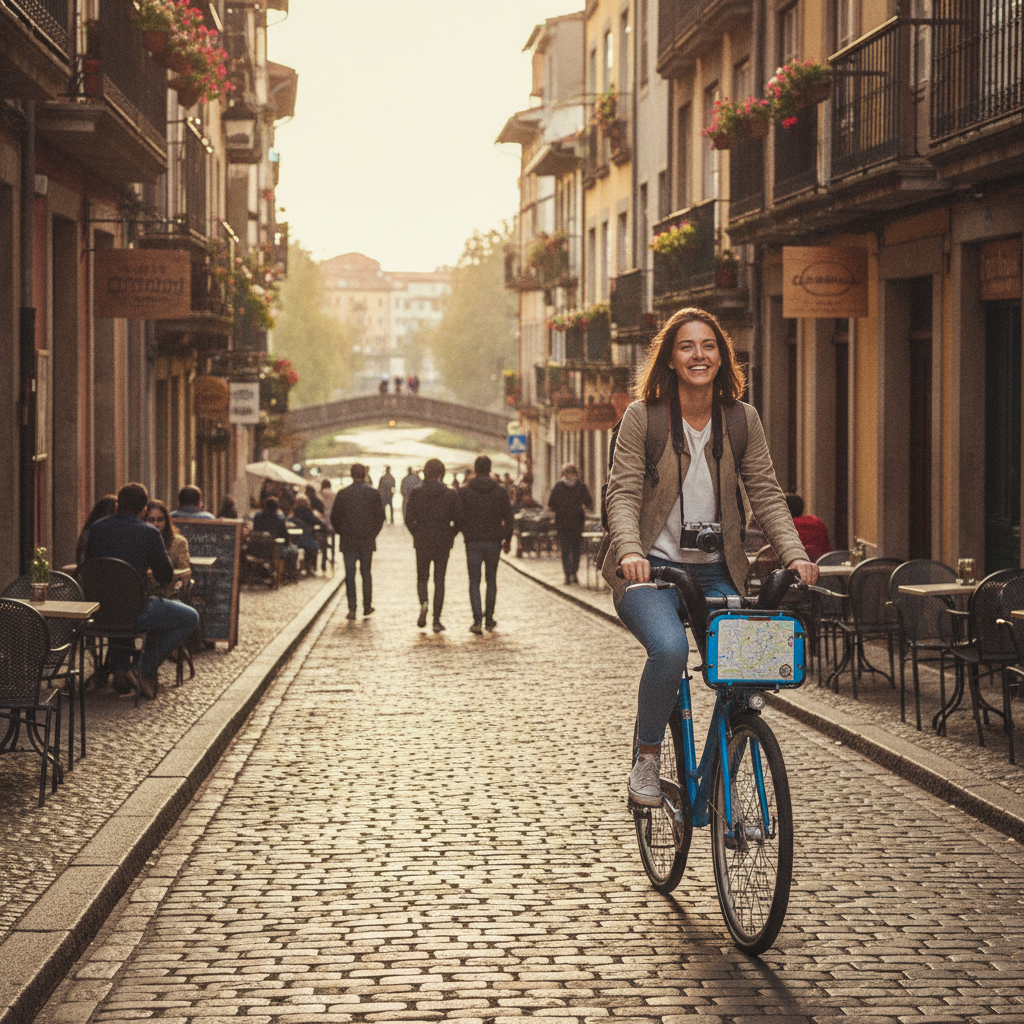
Some of the best travel moments happen in places that never appear on a printed itinerary. You're pedaling slowly through a quiet residential street, catching the smell of something cooking from an open window, watching kids kick a ball around a courtyard — and you realize this is what you came for. City bike-share programs have made this kind of discovery more accessible than ever, giving you the freedom to move at your own pace, stop wherever you want, and cover ground that a taxi would pass in seconds or a tour bus would skip entirely.
Download the App Before You Leave Home
Most major bike-share systems around the world now operate through dedicated apps, and setting yours up before you land saves real time and frustration. Programs like Vélib' in Paris, Citi Bike in New York, and Bicing in Barcelona each have their own platforms, and some require a local phone number or payment verification that can take a few minutes to sort out. Getting familiar with the interface at home also means you'll understand the map view, docking station indicators, and pricing tiers before you're standing on a foreign street corner trying to figure it out. A little preparation goes a long way.
Choose a Day Pass Over Per-Ride Pricing
Bike-share systems almost always offer single-ride rates alongside daily or weekly passes, and if you're planning to hop on and off throughout the day, the pass is almost always the better deal. The per-ride cost tends to seem small until you're on your fourth or fifth trip across a neighborhood. Day passes typically unlock a set number of free minutes per ride — often 30 to 45 minutes — which is more than enough time to reach the next docking station. Build your route around those windows and you'll move through a city efficiently without racking up extra charges.
Learn the Docking Station Logic in Each City
Every city structures its bike-share network a little differently, and understanding the docking pattern helps you plan smarter routes. Dense urban cores tend to have stations every few blocks, while residential and outer neighborhoods may have them spaced further apart. Before you head somewhere unfamiliar, spend a few minutes zooming out on the app map to see where stations thin out. In cities like Amsterdam or Copenhagen, bike infrastructure is so thorough that you rarely need to think twice. In others, you'll want to know where your return point is before you drift too far from it.
Use the Bike to Connect Between Metro Stops
One of the most underused strategies for covering a lot of ground is combining bike-share with public transit. You can take the metro across town and then grab a bike for the last mile exploration — or ride to a station from your accommodation to avoid a crowded transfer. This approach is especially effective in cities where bike lanes run parallel to transit lines, letting you cover a corridor of neighborhoods at street level rather than underground. Cities like Berlin and Lisbon have made this combination increasingly seamless, with stations positioned right at major transit hubs.
Plan Loose Routes, Not Rigid Ones
The real advantage of a bike over a taxi or tour bus is the ability to stop mid-block and change your mind entirely. Give yourself a loose geographic goal — a specific market, a waterfront stretch, a hilltop viewpoint — and let the route between be improvised. If a narrow alley looks interesting, turn into it. If a small square has a few cafe tables and good energy, park the bike and sit for a while. Rigid planning defeats the purpose. The neighborhoods that feel most alive are usually the ones you stumble into rather than schedule.
Know the Local Rules Before You Ride
Traffic laws for cyclists vary significantly from country to country, and even city to city. In some places, riding on the pavement is perfectly acceptable and expected; in others, it carries a fine. Helmet requirements, right-of-way rules, and hand signals all differ. Spending ten minutes reading a basic guide to cycling laws in your destination country — most tourism boards publish these clearly — protects you legally and helps you blend in with local riders rather than looking like someone who just grabbed a bike and guessed. Locals generally appreciate when visitors make the effort.
Use Offline Maps as a Backup
Data coverage isn't always reliable in older city centers with dense architecture, and depending entirely on a live map app while cycling can get you into trouble. Download offline maps through an app like Maps.me or Google Maps before heading out, and mark your starting point, a few docking stations near your planned area, and any specific stops you want to make. This way, if your signal drops in a quiet neighborhood, you're not completely lost. It also means you can keep your phone in your pocket more and your eyes on the street, which is both safer and more enjoyable.
Go Out Early to Catch the City at Its Realest
Bike-share programs run early, and mornings in most cities belong to locals rather than tourists. Heading out before nine means you'll find bakeries that haven't switched to tourist menus yet, markets being set up rather than already packed, and streets where the rhythm feels genuinely lived-in. The light is also better for photography in the early hours, and traffic is generally lighter, making it easier to cross intersections and explore without the pressure of rush-hour congestion. Early rides also free up your afternoons for slower pursuits — long lunches, museums, or simply sitting somewhere good.
Bike-share systems are expanding in scope and quality across cities worldwide, and the technology behind them continues to improve. Real-time availability data, electric-assist options, and better integration with transit apps are all making it easier to build entire days around human-powered exploration. The cities investing most heavily in cycling infrastructure tend to be the ones most worth exploring slowly — and as more destinations recognize this, the opportunity to discover genuinely local neighborhoods on two wheels will only keep growing. Grab a helmet, trust the map, and see what the tour buses missed.