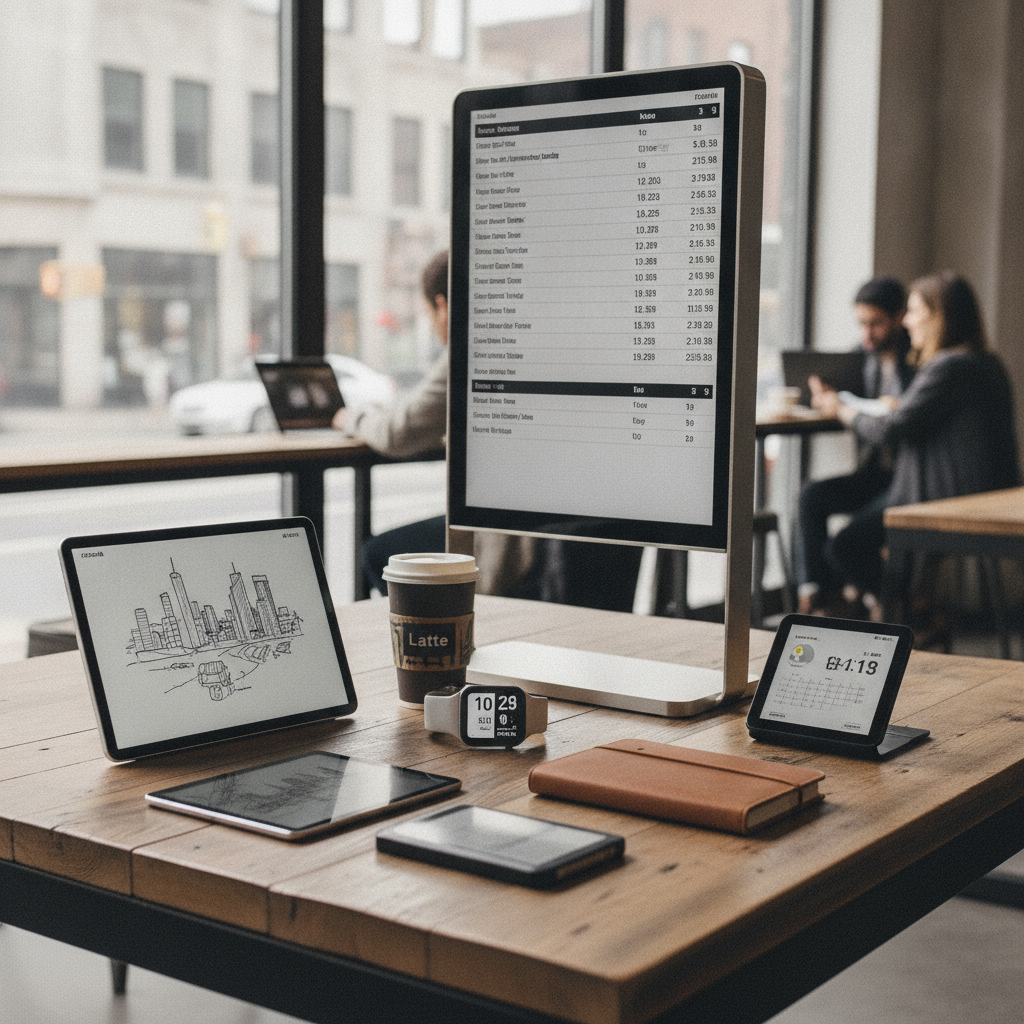
Electronic ink — a display technology that mimics the appearance of printed text by rearranging charged particles between two surfaces — has quietly moved far beyond the Kindle and Kobo readers that first made it familiar to the general public. What began as a niche solution for long-form reading has become an increasingly attractive option for product designers, urban planners, and consumer electronics manufacturers looking for something conventional screens simply cannot offer: a display that consumes almost no power when sitting still. The shift is subtle but measurable, and it says something meaningful about where technology is heading as the world grows more conscious of energy use, screen fatigue, and the environmental cost of always-on devices.
The Physics Behind the Quiet Screen
Understanding why e-ink displays behave the way they do requires a brief look at what makes them structurally different from the LCD or OLED panels that dominate smartphones, laptops, and televisions. In a conventional display, a backlight or pixel-level light source must remain active constantly to keep the image visible — switching it off means the screen goes dark. E-ink works differently. Tiny microcapsules or microcup chambers are filled with dark and light charged particles that move toward the surface when a voltage is applied, and then hold their position once the voltage is removed. The display requires no power to maintain a static image because the particles are physically resting in place, not being held there by electricity. Refresh a page once, and the screen can show that content indefinitely without drawing another milliwatt. This bistable quality — the ability to exist stably in one of two states without continuous energy — is the defining characteristic that makes e-ink so compelling for applications where batteries matter.
Where E-Ink Is Showing Up Now
The expansion of e-ink technology beyond reading devices has followed a predictable logic: wherever a screen needs to display information that changes rarely, e-ink makes more sense than a power-hungry color display. Electronic shelf labels in retail stores like those used by large European supermarket chains replaced printed paper tags years ago, allowing price updates across thousands of products through a central system without anyone walking the floor with a label gun. Smart home hubs and wall-mounted control panels, like certain models from the Boox ecosystem, now use e-ink to show schedules, weather, and home controls in a format that's always readable in bright light without the glow of an active screen disrupting a room's atmosphere. Wearable devices, particularly fitness trackers and minimalist smartwatches, have adopted e-ink to stretch battery life from days into weeks. Even public infrastructure is changing: bus shelters and transit information boards in cities like Amsterdam and Taipei have piloted e-ink signage that can update remotely and run on small solar panels, a combination impossible with conventional display technology.
Some of the most intriguing applications are appearing in professional and industrial settings. Logistics warehouses use e-ink wristbands to display picking instructions for workers, reducing paper waste and simplifying routing without requiring devices to be charged constantly. Medical facilities have experimented with e-ink door displays outside patient rooms that show care instructions, dietary restrictions, and nurse assignments — information that changes occasionally throughout the day but needs to be consistently visible. The Remarkable tablet, which uses an e-ink surface optimized for writing, found a loyal following among academics and professionals who found the paper-like experience of digital note-taking genuinely different from anything a glass-covered touchscreen could offer.
What Low Power Demands Actually Change
The energy implications of e-ink technology extend further than battery life statistics might suggest. Modern consumer culture is deeply entangled with the expectation of constant connectivity, frequent charging, and device ecosystems that demand daily attention. A smartwatch that needs to be charged every night is an additional obligation woven into a person's routine; one that runs for three weeks on a single charge simply recedes into the background, becoming a tool rather than a responsibility. This shift in cognitive overhead — the mental energy spent managing devices — is something that's easy to underestimate until it's gone.
For devices that are meant to be passive or ambient, the case for e-ink becomes even stronger. A digital photo frame that can display a rotating selection of family images while drawing almost no power is fundamentally different from a tablet propped against the wall burning through electricity. Smart building systems that display room occupancy or environmental data can use e-ink panels without needing dedicated power lines run to each display. The sustainability dimension is real, too. As global attention turns toward the energy consumption of technology infrastructure, devices that do more with less electricity become genuinely preferable rather than merely convenient. E-ink doesn't solve every display problem — it refreshes slowly, struggles with video, and until recently produced only limited color — but for information that sits still, it may be the most honest match between a technology and its purpose.
Color E-Ink and the Next Generation of Displays
For much of its history, e-ink's most visible limitation was its palette: crisp black and white, but little else. That constraint has eroded significantly. Manufacturers including E Ink Holdings, the Taiwanese company that holds much of the core intellectual property, have developed color variants like Kaleido and Gallery 3 that display a meaningful range of hues at acceptable refresh speeds. These newer panels have opened doors in signage, packaging displays, and consumer products where color matters. The tradeoff remains — color e-ink is still slower and less vibrant than an OLED display — but for applications like museum information panels, retail end caps, or book covers that change, the color rendering is more than adequate. The technology continues to improve with each product cycle, and the gap between what e-ink can show and what a backlit screen can show is narrowing in contexts where motion and brightness aren't requirements.
What This Means for the Way You Use Technology
If you pay attention to where your own energy goes — both your body's and your devices' — e-ink surfaces start to look less like a compromise and more like a considered choice. A secondary screen on a desk that shows a calendar, your task list, or an ambient weather display without demanding a charger represents a different kind of relationship with information: quieter, less urgent, less draining. Devices built around e-ink tend to invite slower, more deliberate interaction — reading rather than scrolling, glancing rather than staring. That's not a weakness; it's a design philosophy that pushes back, gently, against the relentless brightness and stimulation of most modern screens.
The spread of e-ink technology into everyday objects reflects something broader about the direction thoughtful design is moving. Just as the earliest e-readers demonstrated that millions of people were willing to read long-form text on a screen that looked nothing like a television, the current wave of e-ink applications is demonstrating that a display doesn't need to be fast, vivid, or backlit to be genuinely useful. The technology that once made reading quietly in bright sunlight possible is now quietly working its way into the walls, wrists, and workspaces of daily life — doing its job while drawing almost no attention and almost no power.