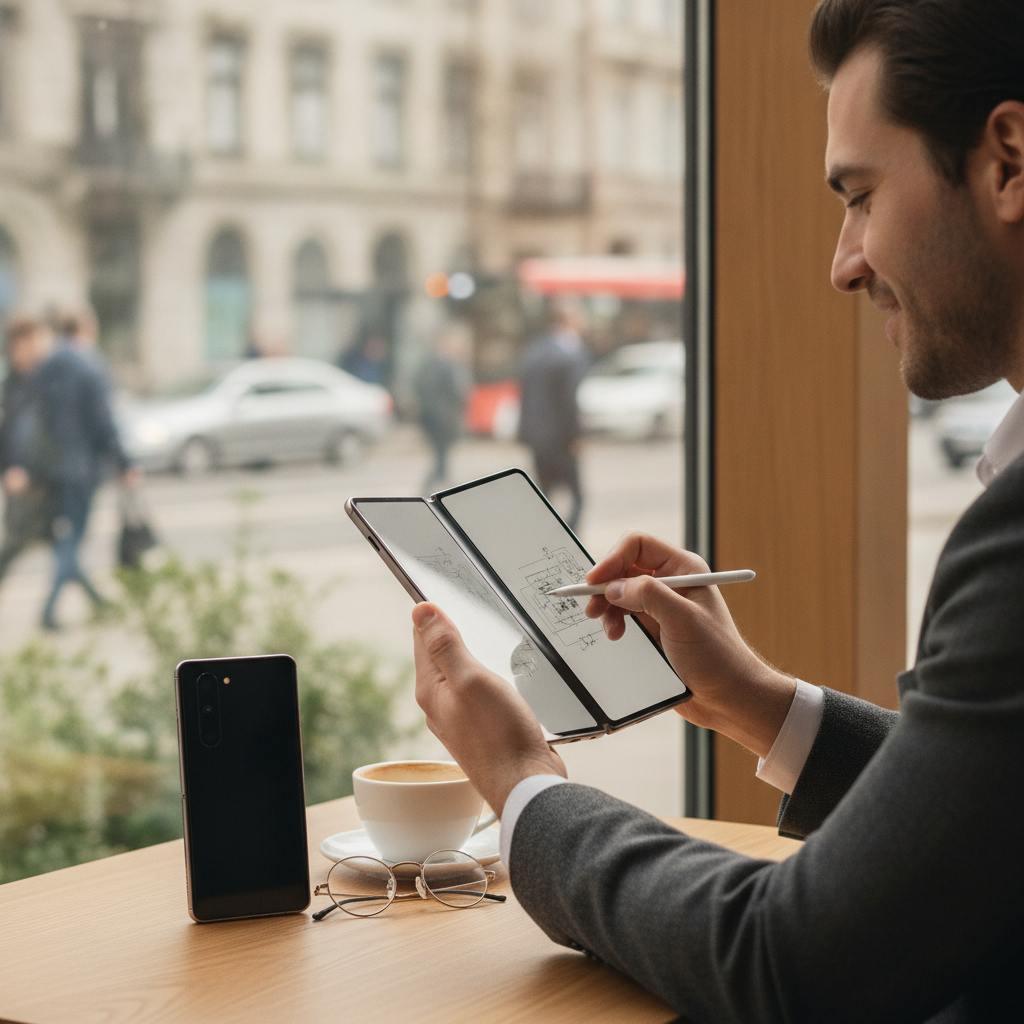
There was a time, not so long ago, when pulling out a foldable phone in a coffee shop felt less like using a tool and more like making a statement. The device announced itself — its unusual proportions, its audible crease, its deliberate theatricality. People glanced. Conversations started. The phone itself felt more like a conversation piece than a communication device. That era, defined by early-adopter enthusiasm and conspicuous engineering, has quietly given way to something more grounded. Foldable phones have stopped trying to impress and started trying to be useful, and in doing so, they've crossed a threshold that few predicted would arrive this cleanly.
The Engineering Maturity Behind the Shift
The earliest foldable devices from Samsung and Huawei were remarkable demonstrations of what was possible, but they were also fragile, expensive, and prone to failures that made daily reliance feel like a gamble. The hinge mechanisms — the mechanical soul of any foldable — were vulnerable to dust, moisture, and the simple wear of repeated folding. Screen creases were visible and tactile, a constant reminder that this was prototype thinking dressed as consumer product. What has changed, incrementally but decisively, is the depth of engineering refinement behind these components. Modern foldable hinges are rated for hundreds of thousands of folds, the crease has softened to near-invisibility on the best devices, and water resistance ratings that once seemed aspirational have become standard. The hardware has grown up.
Why the Form Factor Now Makes Practical Sense
There is a concept in industrial design sometimes called *form follows function* — the idea that a product's shape should emerge from its purpose rather than precede it. For years, foldable phones inverted this principle, offering a dramatic form in search of a compelling function. That relationship has corrected itself. A phone that unfolds into a compact tablet genuinely changes how someone reads a long article, reviews a document, or watches a short video during a commute. The Google Pixel Fold and Samsung Galaxy Z Fold series have iterated toward software experiences that take real advantage of the expanded canvas, with apps that reflow intelligently rather than simply stretching a phone-sized interface across a larger display. The function has caught up to the form, and that alignment is what daily usability requires.
Durability and the Trust Problem
Perhaps the most significant barrier to foldable adoption was never the price — though the price remained steep — but trust. Consumers build habits around their phones in ways they rarely articulate. A device gets dropped, carried through rain, stuffed into a bag alongside keys and coins, and expected to survive all of it without ceremony. Early foldables asked users to treat them gently, which runs directly against the unconscious relationship most people have with their devices. The durability improvements in recent generations have done quiet but essential work here. Corning's Gorilla Glass adaptations for flexible displays, tighter IPX ratings, and reinforced hinge materials have collectively moved foldables from "handle with care" to "handle normally," which is the only standard that matters for something carried every day.
Cultural Adoption and the *Seikatsu* Approach
In Japanese, the word *seikatsu* (生活) describes everyday life in its most practical, unglamorous sense — the rhythms of work, meals, transit, and rest that constitute ordinary existence. For a technology to earn a place in someone's *seikatsu*, it must justify itself through ease, not novelty. Foldable phones are finally beginning to pass that test in markets where they've had the longest exposure. In South Korea and Japan, where compact design and multitasking efficiency carry particular cultural weight, foldable adoption rates have grown steadily rather than spiking and retreating. This kind of quiet, sustained uptake is the truest signal of genuine integration. It suggests that people are finding these devices useful across the full texture of their days, not just in moments designed to show them off.
What Changes When Your Phone Also Becomes a Screen
The practical implications of carrying a device that can serve as both a phone and a modest tablet are more significant than they might first appear. For someone who travels frequently, reviews contracts remotely, or relies on split-screen multitasking to manage work and communication simultaneously, the foldable form factor reduces the number of devices that need to be carried. The iPad-plus-iPhone combination that many professionals have maintained for years begins to look redundant when a single folding device handles both roles with reasonable competence. Microsoft's integration of its Office suite with Samsung's foldable line has made this particular use case more compelling, and the continued refinement of Android's large-screen mode has closed gaps that once made tablet-mode apps feel like afterthoughts.
The Price Curve and What It Signals
Premium technology tends to follow a predictable arc: it launches at a price that limits it to enthusiasts, then descends gradually as manufacturing scales and competition increases. Foldables are moving along that arc, though more slowly than some predicted. What's more telling than the absolute price, however, is what that price now buys. Spending on a flagship foldable today delivers a device that competes directly with the best traditional flagships on camera performance, processor speed, and software support — with the added dimension of the flexible display. The value equation has shifted. It's no longer a question of paying a premium for an experimental feature; it's a question of whether the foldable form factor is worth the difference over a conventional phone, and for a growing number of people, the answer is becoming yes.
Choosing to Live With One
If you've been watching foldables from a distance, waiting for the technology to settle, the current generation represents the closest thing to a natural entry point this category has offered. The practical questions worth asking are specific: how much of your day involves reading or reviewing content on a screen, whether you already carry a tablet alongside your phone, and how much you value having a compact device that expands when the task demands it. The Galaxy Z Fold or Pixel Fold won't suit everyone — someone who primarily needs a reliable camera and fast messaging may find little reason to leave a conventional flagship. But for those whose digital lives involve genuine multitasking, document review, or extended screen time, the foldable has quietly become a reasonable choice rather than an indulgent one.
The coffee shop moment that once felt theatrical has settled into something more ordinary. The person unfolding their phone to read, to work, to watch — they're no longer making a statement. They're just using their phone. That, in the end, is the only arrival that matters.