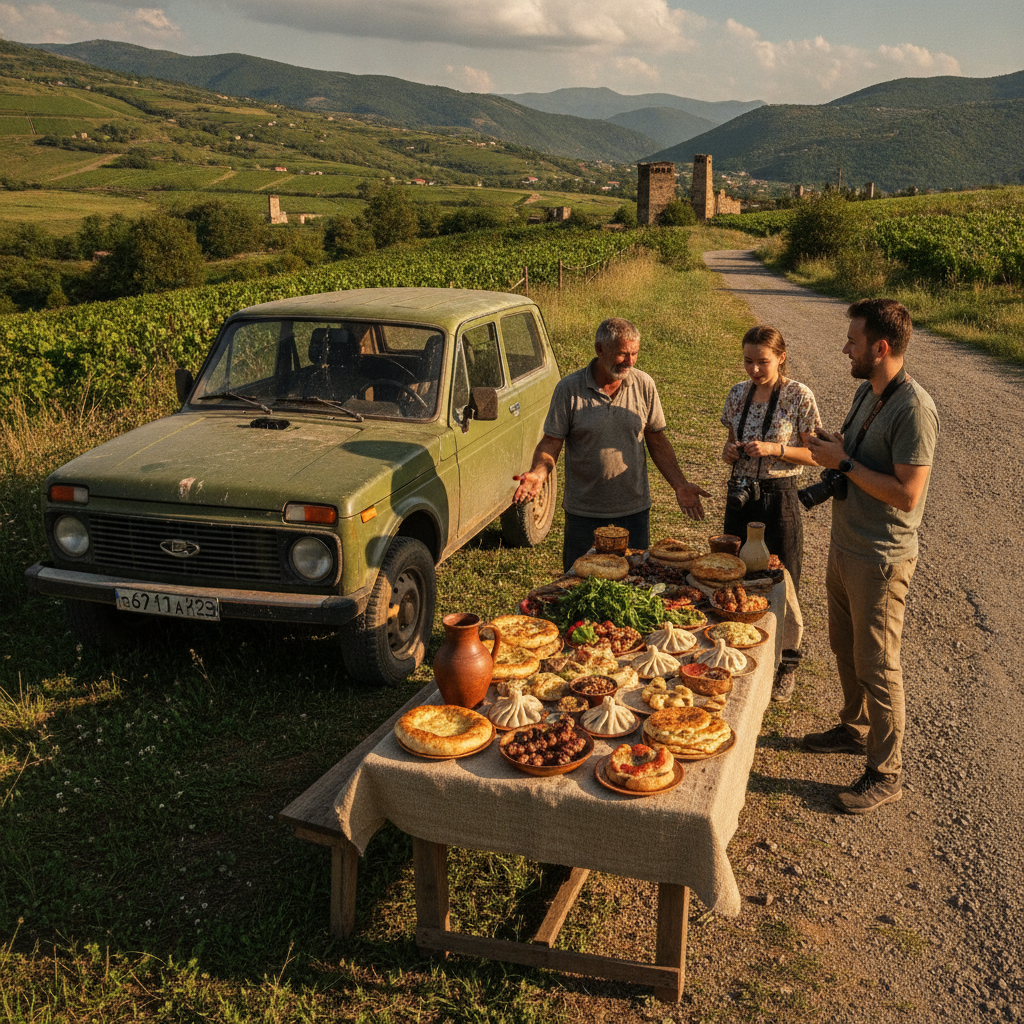
Some places reveal themselves slowly, and Georgia — the South Caucasus nation wedged between Russia, Turkey, Armenia, and Azerbaijan — is precisely that kind of country. Organized tours tend to move efficiently between UNESCO sites and curated dinner tables, delivering a polished version of a place that, while pleasant, rarely surprises. The traveler who rents a small car in Tbilisi and simply drives, however, discovers something the itinerary cannot manufacture: a culture of hospitality so deeply embedded in daily life that it functions less like a tradition and more like a moral obligation.
The Road as the Real Itinerary
Driving east through the Alazani Valley or climbing the Military Highway toward Kazbegi puts a traveler in direct contact with the rhythms of Georgian life that organized coaches skip by design. The roads are imperfect, sometimes unpaved, and occasionally occupied by unhurried livestock — but these are precisely the conditions that force unscheduled stops, unexpected conversations, and the kind of spontaneous detours that become the stories people carry home. A village roadside stand selling churchkhela — walnut strings dipped in thickened grape juice — offers more cultural texture in five minutes than a rehearsed cooking demonstration at a Tbilisi hotel. The physical act of figuring out where to stop, where to sleep, and where to eat compresses a traveler into the same daily decision-making that locals navigate, creating a kind of low-level intimacy with a place that guided tours deliberately smooth over.
Tamada, Supra, and the Weight of a Georgian Table
No understanding of Georgia is complete without sitting at a proper supra, the elaborate feast that functions as the country's primary social institution. A supra is not simply a meal — it is a structured ceremony presided over by a tamada, or toastmaster, whose role involves guiding guests through a sequence of toasts that move from God and Georgia to family, the dead, children, love, and peace. Tour packages occasionally arrange a supra experience, but these tend to be abbreviated and staged. The self-guided traveler who accepts an invitation from a guesthouse owner in Sighnaghi or a farming family near Gori encounters the real thing: a table that keeps expanding, wine poured from a clay pitcher, and a host who considers it a personal failure if a guest leaves anything but completely satisfied. The Georgian concept of "guest is a gift from God" — a phrase locals repeat without irony — is not a marketing slogan but a lived philosophy that shapes how strangers are received everywhere from mountain villages to urban apartments.
What the Wine Tells You
Georgia is widely regarded as one of the oldest wine-producing regions in the world, and the country's qvevri method — fermenting wine in large clay vessels buried underground — has been practiced for roughly eight thousand years. Most wine tourism funnels visitors toward the polished tasting rooms of the Kakheti region near Telavi, which are lovely but curated. The road trip traveler who asks a local where they actually buy wine often ends up in someone's cellar, tasting something unlabeled, amber-colored, and slightly tannic from a plastic cup — a natural wine made with skin contact that bears almost no resemblance to what most Western palates expect. This is Georgian wine in its least performative form, and tasting it in context, surrounded by the vines that produced it and the family that tends them, communicates something about agricultural identity and pride that no tasting notes can capture.
Bread, Cheese, and the Grammar of Georgian Food
Georgian cuisine operates on a logic of abundance and regional variation that tour menus rarely honor. Khachapuri — the cheese-filled bread that has become the country's most exported culinary symbol — takes entirely different forms depending on where one eats it. The Adjarian version, shaped like a boat and topped with a raw egg and butter, bears little resemblance to the flatter, crispier Imeretian style. Mchadi, a dense cornbread eaten in western Georgia, reflects entirely different agricultural traditions from the wheat-based breads of the east. A traveler moving independently through these regions encounters this variation naturally, eating in small roadside restaurants where the menu is whatever was cooked that morning and the price is rarely written down. The food is not exotic — it is honest, seasonal, and prepared with the assumption that the person eating it understands what good ingredients taste like.
Hospitality as Infrastructure
In rural Georgia, guesthouses — called either binebi or simply the family's house with a spare room — function as the de facto accommodation infrastructure outside major cities. Booking platforms like Booking.com list some of these, but many operate entirely through word of mouth or a hand-lettered sign at the village entrance. Staying in one of these places collapses the usual distance between traveler and host in ways that hotel lobbies are designed to prevent. Breakfast appears without being ordered, laundry is done without being asked, and the family patriarch often sits down to explain, through a translator app or patient gesture, exactly what the valley looked like before the Soviet roads were built. These interactions are not performances of hospitality — they are hospitality, extended with the same naturalness that a person might offer a glass of water.
What Gets Lost in Translation on a Guided Tour
The frustration of an organized tour through Georgia is not that it shows the wrong things — it's that it shows the right things too quickly and too cleanly. Mtskheta, the ancient capital near Tbilisi, is genuinely extraordinary, and Vardzia, the cave monastery carved into a volcanic cliff, demands to be seen. But arriving at these sites in a bus with thirty other people and forty minutes on the clock produces a fundamentally different experience than arriving alone after a long drive, parking beside a farmer's truck, and eating a picnic of lavash and sulguni cheese on a hillside before walking in. The tour package optimizes for coverage; the road trip optimizes for absorption. Georgia, more than most countries, rewards the latter — because its greatest cultural offerings are not the monuments but the people who live around them, and those people require time and stillness to encounter properly.
The traveler who eventually returns the rental car in Tbilisi and sits in a café on Rustaveli Avenue carries something back that no itinerary could have planned: the memory of a table that kept growing, wine poured from underground clay, bread pulled from a wood-fired oven, and the specific quality of welcome that a country extends when it is not being watched. That is what Georgia offers to those who arrive without a schedule — not a destination, but a disposition toward the world that quietly rearranges how one thinks about what it means to feed another person and call them a guest.