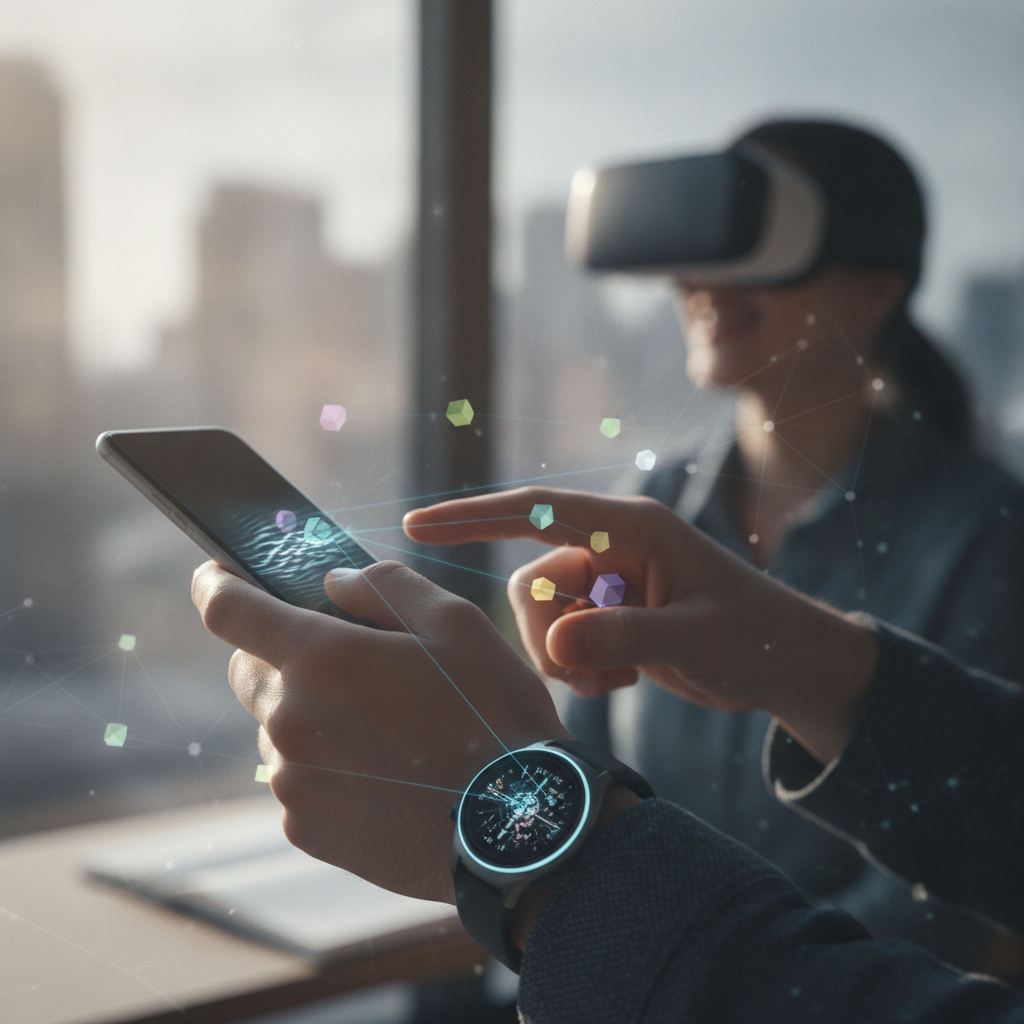
Touch has always been one of the most direct forms of communication, and technology is slowly learning to speak that language. Haptic feedback — the use of physical sensations to convey information through a device — has moved well past the coarse buzzes of early smartphones into a discipline that engineers and designers treat with the same seriousness as sound and visual design. What was once a single-note notification system is becoming a full sensory vocabulary, one that promises to change how people relate to their devices on a fundamentally physical level.
From Coin Motors to Precision Actuators
For most of the smartphone era, haptic feedback meant a small eccentric rotating mass motor — a coin-sized mechanism that spun an off-center weight to create vibration. The sensation was blunt and imprecise, more alert than communication. The shift began when Apple introduced the Taptic Engine in the iPhone 6S, replacing that spinning motor with a linear resonant actuator capable of producing sharp, directional pulses. That change established a new baseline. Instead of feeling a device buzz, users began to feel distinct clicks, taps, and rhythmic patterns that corresponded to specific interactions — keyboard presses, scroll stops, confirmation moments.
What Precision Haptics Actually Feels Like in Practice
Modern implementations have grown sophisticated enough that the sensation of tapping a virtual button on an iPhone or a Galaxy S-series device can feel meaningfully different from scrolling through a list or receiving a message. Samsung's Game Vibration feature, for instance, maps different haptic intensities to different in-game events, letting players feel an explosion differently from a footstep. Apple's haptics team has spent years fine-tuning the timing and intensity curves of interactions so that even subtle moments — like the satisfying thud when a dragged icon snaps into place — carry physical weight. These aren't gimmicks; they reduce cognitive load by letting the body confirm actions without the eyes.
Wearables Are Pushing the Language Further
Smartwatch platforms have adopted haptic design as a core interface element, partly because small screens make visual feedback limited and audio feedback often inappropriate. The Apple Watch uses what Apple calls Taptic patterns — distinct rhythmic sequences that communicate directions during navigation, incoming call types, and health alerts without requiring the user to look at the display. Garmin has developed similar approaches for fitness wearables, where a specific pattern signals the end of a workout interval versus a heart rate warning. The underlying idea is that the wrist is already primed for subtle physical signals, and devices can exploit that sensitivity to communicate efficiently in contexts where a glance at a screen isn't practical.
The Science of Skin and Signal Design
Haptic design draws on a real body of sensory science. The skin contains multiple receptor types that respond differently to pressure, vibration, and texture — Meissner's corpuscles detect light touch and low-frequency vibration, while Pacinian corpuscles respond to high-frequency signals deeper in tissue. Effective haptic engineers work within those biological parameters, selecting frequencies and amplitudes that feel crisp rather than muddy. Frequencies in the range of 150 to 300 Hz tend to produce sensations that humans interpret as taps or clicks, while lower frequencies register as thuds or rumbles. Companies like Immersion Corporation have built entire patent libraries around mapping these biological responses to device output, licensing the technology to manufacturers across the industry.
Where the Technology Is Heading Next
Research labs and startups are working on the next generation of haptic experiences that go well beyond what any current consumer device can produce. Mid-air haptics — systems that use focused ultrasound arrays to create tactile sensations without physical contact — have been demonstrated in prototype form by companies including Ultrahaptics, now operating as Ultraleap. Electrostatic surface haptics, which modulate the friction a fingertip feels while sliding across a touchscreen, could allow future tablets and phones to simulate the texture of different surfaces. Meanwhile, glove-based haptic systems designed for extended reality environments are inching closer to consumer viability, driven by growing interest in immersive applications across entertainment and professional training.
What This Means for How You Use Your Devices
If you own a recent iPhone, Galaxy, or Apple Watch, you're already interacting with haptics far more capable than most people realize — and most of that capability sits in default settings that reward exploration. Spending a few minutes inside your phone's accessibility and sound settings to experiment with haptic intensity levels can change how interactions feel across every app. On Apple Watch, enabling the Taptic Chime or adjusting haptic strength for notifications can make the device feel more responsive without adding noise to your environment. As wearables become more capable and haptic patterns become more standardized, the physical feedback layer of your devices will carry as much design intention as the icons on your screen — and paying attention to it now means you'll be better prepared to take advantage of what's coming.
The arc of haptic technology points clearly toward a world where physical sensation is a genuine information channel rather than a simple alert system. As actuator hardware grows more precise, software frameworks more expressive, and device form factors more varied, the gap between touching a screen and feeling a meaningful response will continue to narrow. For consumers and developers alike, that shift represents one of the more underappreciated transitions in modern device design — a quiet revolution unfolding beneath the fingertips.