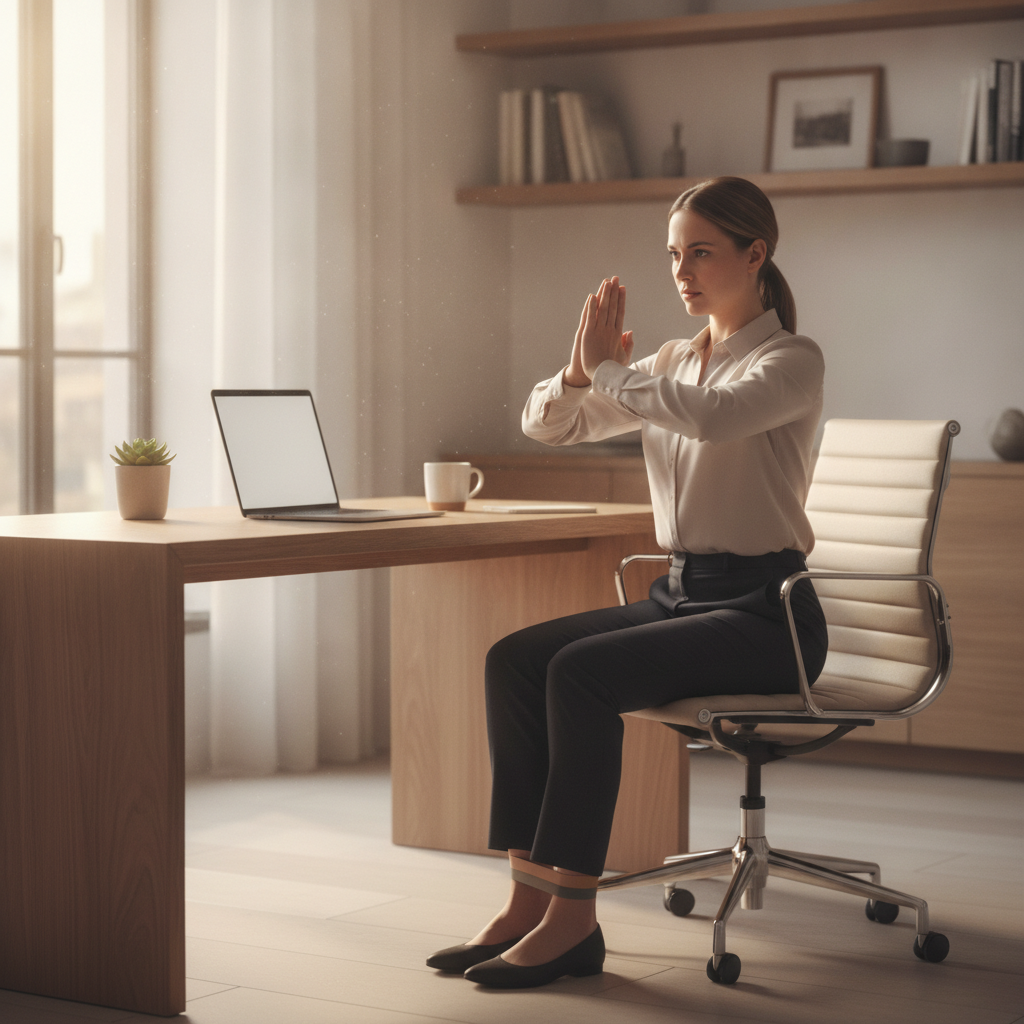
Strength building has never required a barbell, a membership card, or even a change of clothes. Isometric exercise — the practice of contracting muscles against a fixed resistance without joint movement — has been quietly effective for decades, and it fits inside a desk-bound schedule with almost no friction. For people who spend six to nine hours seated each day, these static holds offer a practical path toward genuine muscular development, better posture, and reduced physical stagnation.
What Makes Isometric Exercise Different From Other Training?
Most familiar forms of exercise involve dynamic movement — joints bend, muscles lengthen and shorten through a full range of motion. Isometrics work differently. The muscle contracts fully and holds against resistance, but the joint stays still. Pressing palms together at chest height, holding a wall sit, or gripping a desk edge and pulling upward all generate significant muscular tension without a single rep in the traditional sense. This quality makes isometrics uniquely adaptable to small spaces, professional environments, and schedules that leave no room for dedicated workout sessions.
How Muscles Actually Respond to Static Holds
The mechanism behind isometric strength gains is well understood. When a muscle sustains tension for an extended period — typically anywhere from five seconds to sixty seconds — motor units are recruited progressively as fatigued fibers hand off the load. This cascading recruitment mirrors what happens during heavy dynamic lifts. The result is genuine neuromuscular adaptation. Over consistent weeks of practice, muscles grow more efficient at generating force, and connective tissue around tendons strengthens as well. Research in physical rehabilitation has long used isometric protocols precisely because the strength gains are real, measurable, and transferable to everyday movement.
Which Exercises Work Best at a Desk or Workstation?
The range of isometric exercises available to seated workers is broader than most people assume. A few particularly effective options require no equipment at all.
- **Chair press-up:** Palms flat on armrests, arms straightened partially, hold for ten to thirty seconds. Engages triceps and shoulders.
- **Desk push:** Place both palms under a sturdy desk edge and press upward without lifting it. Targets biceps, forearms, and upper back.
- **Seated glute squeeze:** Contract both glutes firmly and hold for fifteen to thirty seconds. Counteracts hip flexor tightening from prolonged sitting.
- **Isometric neck resistance:** Place one palm against the side of the head and press gently inward while resisting with neck muscles. Builds cervical stability often neglected in desk workers.
- **Core abdominal brace:** Draw the navel inward slightly, tighten the deep abdominal wall, and hold while breathing normally through a full work task.
Apps like Streaks or Habitica can help build consistent daily reminders around these movements without requiring any manual tracking.
How Often Should These Holds Be Performed During a Work Day?
Frequency matters more than duration with isometric work performed throughout the day. Brief, repeated sessions outperform a single prolonged block. Fitting in three to five isometric holds per muscle group throughout an eight-hour workday — roughly one set every ninety minutes — produces a cumulative training effect that rivals short gym sessions for desk workers with limited mobility time. The key is distributing effort across the day rather than clustering it. Setting a soft reminder using something as simple as a Google Calendar recurring event or the built-in focus timer on macOS keeps the habit anchored without disrupting concentration.
What Isometrics Do for Posture and Joint Health Over Time
Sedentary work creates predictable muscular imbalances. Hip flexors shorten, thoracic extensors weaken, and the deep stabilizing muscles of the spine disengage from underuse. Isometric training applied consistently to these neglected muscle groups restores balance. Holding a deep core brace while typing strengthens the transverse abdominis without requiring a single crunch. Isometric rows — pulling the shoulder blades together and holding — activate rhomboids and mid-trapezius muscles that slump forward during prolonged screen time. The cumulative effect over weeks is measurable in both posture and in reduced lower back tension, two outcomes that directly affect how a person feels by the end of the workday.
How You Can Build This Into Your Routine Starting Today
The most effective approach is attaching isometric holds to existing work habits rather than treating them as separate tasks. Every time you finish sending an email, add a thirty-second glute squeeze. Every time a video call begins, hold a seated core brace for the first minute. Every time you refill a water bottle, do a desk push on the way back to your chair. This habit-stacking technique — popularized in behavioral research and discussed at length in frameworks used by wellness coaches at organizations like the Mayo Clinic Healthy Living Program — eliminates the need for willpower or scheduling. The movement simply becomes part of the rhythm of the day.
Start with three exercises and two sessions each per day. Track consistency for two weeks before adding new movements. Progress is made by increasing hold duration — not by adding more exercises prematurely. A ten-second hold becomes twenty, then forty. Difficulty builds naturally, and strength follows.
Isometric training sits at the intersection of accessibility and effectiveness, and that position is only becoming more relevant as hybrid and fully remote work arrangements extend average daily sitting time for millions of professionals. Wearable devices from companies like Garmin and Whoop are beginning to incorporate inactivity reminders and muscular engagement prompts that align directly with isometric protocols, suggesting that structured desk-based strength training may eventually become a built-in feature of the workday itself. The tools are evolving to meet people where they already are — seated, connected, and looking for ways to move without stopping.