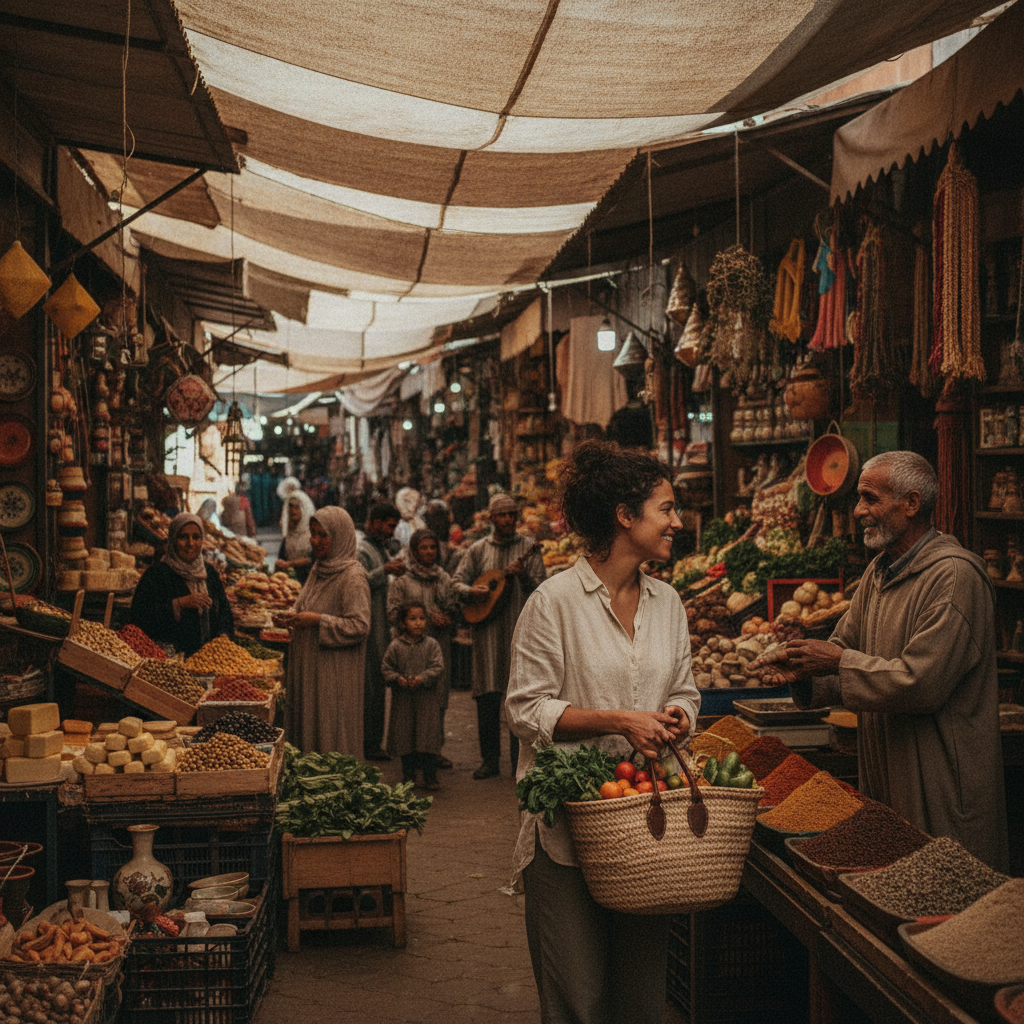
There is a particular kind of knowledge that only comes from standing in the middle of an open-air market at eight in the morning, surrounded by strangers speaking a language you're still learning, holding a vegetable you can't name. Restaurants, however excellent, are edited experiences — curated, plated, and translated for the visitor. Markets are something else entirely. They are unfiltered cross-sections of daily life, places where the rhythms of a culture become visible not through performance but through the ordinary business of feeding people. For travelers willing to arrive early and stay curious, a local weekly market offers an education that no menu or guidebook can replicate.
What the Stalls Reveal About a Region's Priorities
The layout of a market tells a story before a single word is exchanged. In the sprawling Mercado de San Telmo in Buenos Aires, the mix of fresh produce, cured meats, and antique silverware in adjacent stalls reflects a city that sees no contradiction between the practical and the beautiful. At the weekly Chiang Mai Saturday Walking Street in northern Thailand, street food vendors position themselves according to unspoken rules of tradition and foot traffic that locals understand intuitively but visitors must learn by observation. What a culture chooses to sell in public, and how it organizes that selling, communicates something about collective values — what is considered fresh, what is considered precious, and what is considered ordinary. The sheer abundance of a particular ingredient, whether it's dried chilis in Oaxaca or three varieties of fermented black bean paste in a South Korean jangter, signals what a cuisine actually depends on rather than what it chooses to showcase for outsiders. Restaurants highlight; markets reveal.
The social architecture of these spaces is equally informative. Regulars and vendors greet each other with the familiarity of long association, often exchanging news before exchanging money. A shopper might receive an unsolicited taste of a new cheese, a sprig of herb tucked into a bag as a gift, or a gentle correction when reaching for the wrong variety of a fruit. These small transactions communicate a great deal about how a community understands generosity, commerce, and neighborliness — categories that overlap differently in different parts of the world. The French concept of *terroir*, often used to describe wine but applicable to any food tied to a specific place and its conditions, becomes something you can smell and touch in a market in Provence on a Friday morning in ways that no restaurant's regional tasting menu can fully translate.
The Language of Food Beyond the Plate
Food in a market context carries meaning that the restaurant setting strips away almost by necessity. A restaurant serves a dish; a market shows you where that dish begins, who grows it, how it's handled before it reaches any kitchen, and what it costs in both money and labor. Watching a vendor in Marrakech's Mellah district sort saffron threads by hand, separating grades with a speed born of decades of practice, makes the spice feel irreducibly real in a way that encountering it in a tagine at a tourist-facing riad does not. The ingredient has a biography. It comes from somewhere specific, grown under specific conditions, harvested by people whose faces and names belong to a place.
This biographical quality of market food also changes how travelers understand unfamiliar ingredients. A fruit that looks alarming — the rambutan's hair-like exterior, the durian's notorious armor — becomes approachable when a vendor offers a segment across a folding table with the straightforward confidence of someone offering something universally known to be good. The social context dissolves hesitation. Markets are also where regional variations within a national cuisine become apparent: two vendors selling the same preserved fish might have products that taste entirely different, reflecting different villages, different methods, different generations of knowledge. That granularity rarely survives the journey from local kitchen to tourist restaurant.
Community as the Real Destination
Perhaps the most significant thing a weekly market offers a traveler is not any particular product but access to a community in an unguarded moment. Markets are one of the few public spaces in most cultures where people of different ages, income levels, and social positions occupy the same square footage with roughly equal footing. An elderly woman negotiating the price of bitter melon and a young professional choosing between two olive oils are both simply people doing what people have done in that place for generations. For a traveler who has spent most of the trip moving between hotels and restaurants designed to absorb visitors gracefully but at a comfortable distance, stepping into that shared space feels qualitatively different.
The rhythm of a market also teaches patience and presence in a way that more structured attractions do not. There is no single correct path through a market, no admission time, no scheduled demonstration. The experience rewards those who slow down, double back, and allow themselves to get slightly lost among stalls selling things they didn't come looking for. That quality of unhurried, directionless attention is itself a form of cultural literacy — a way of signaling to the people around you that you're not extracting a highlight reel but genuinely present in a place.
If you find yourself near a weekly market on your next trip — whether it's the Sunday Brocante markets scattered across Provence, the earthy morning gatherings in rural Vietnam, or the vast weekend produce markets outside Mexico City — consider arriving before the crowds and without a plan. Buy something unfamiliar. Ask, however haltingly, what it's called. Notice what people carry home in their bags and how vendors arrange what remains at the end of the morning. The market that seemed like a pleasant detour from the main itinerary has a way of becoming the detail that stays with you longest — the moment when a foreign place stopped being a backdrop and started feeling, briefly and memorably, like somewhere you might actually understand.