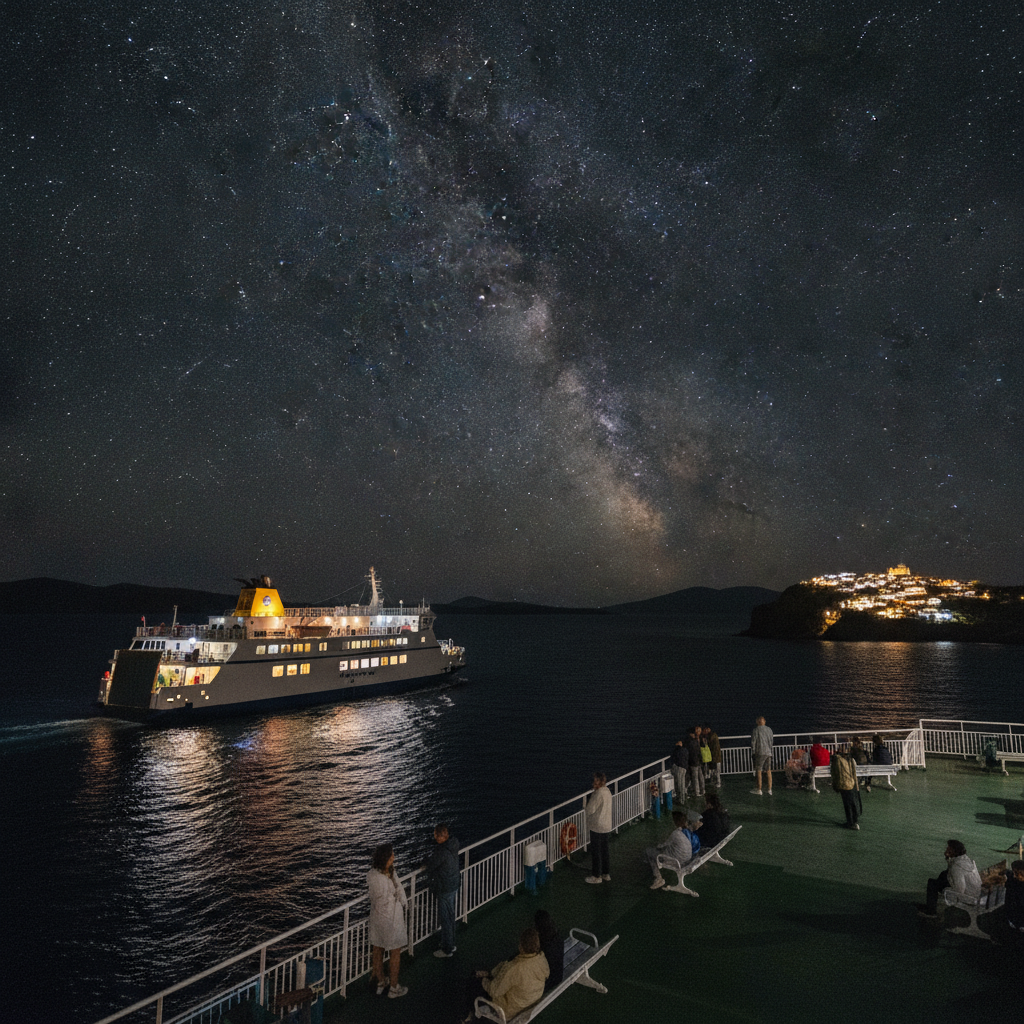
There is a particular kind of traveler who discovers, almost by accident, that the best parts of Greece have nothing to do with peak-hour arrivals or carefully scheduled excursions. They board a ferry after sunset in Piraeus — the great port city just south of Athens — carrying a small bag and a loose itinerary, and by the time they wake up somewhere in the Cyclades, they understand something about slow travel that no guidebook quite manages to explain. The night ferry is not merely a mode of transport. For those willing to let go of daylight efficiency, it becomes one of the most honest encounters with Greek island culture available to the independent traveler.
The Economics of Traveling After Dark
Night ferries across the Greek islands operate on a different pricing logic than their daytime counterparts, and the difference is consistently meaningful for budget-conscious travelers. The same route between Piraeus and Santorini — or between Mykonos and Heraklion — typically costs less when booked on an overnight departure, in part because the perceived convenience is lower and demand shifts accordingly. Ferry operators like ANEK Lines and Minoan Lines run fleets that include cabin-class options, and a shared or private cabin on an overnight crossing often works out to less than a night in even a modest guesthouse on the islands themselves. When travelers account for both the transportation fare and the accommodation they would otherwise pay for separately, the overnight ferry begins to look less like a compromise and more like a practical strategy.
This kind of layered savings is rarely obvious when planning from home, but experienced island hoppers quickly learn to build their routes around the overnight schedule. The Greek ferry network, coordinated in part through booking platforms like Ferryhopper, publishes seasonal timetables well in advance, making it possible to chain together multi-island itineraries — say, Athens to Naxos, then Naxos to Ios, then Ios to Crete — almost entirely by night, arriving at each destination with a full day ahead and no accommodation paid for the crossing.
What the Deck Teaches That the Daytime Hides
There is something almost ceremonial about standing on the outer deck of a Greek ferry as it clears a harbor after dark. The island lights contract into a single glowing shape, then soften, then disappear entirely into the Aegean darkness. What remains is the sound of water against the hull, the occasional silhouette of another vessel moving in the opposite direction, and the particular quiet of open sea at night. This is not a manufactured experience. It belongs to the Greeks as much as to any tourist — to the fisherman returning home to Paros, to the university student heading back to Thessaloniki, to the elderly woman with a cloth bag who boards at every stop and seems to know every crew member by name.
Daytime crossings are scenic in a postcard sense — blue water, white hills, the famous light of the Aegean. But they reveal the islands as destinations, as products of tourism. The night crossing reveals them as places where people actually live. Fellow passengers on an overnight ferry tend to be residents, seasonal workers, and the kind of independent traveler who has stopped optimizing their trip and started simply inhabiting it. The conversation, when it happens, tends to be more genuine. The atmosphere, even in silence, carries the texture of real Greek life in a way that no beachside café quite replicates.
Understanding the Ferry Culture and What to Expect
For the uninitiated, Greek ferry travel comes with its own vocabulary and customs worth understanding before boarding. The concept of *filoxenia* — the Greek tradition of warmth and hospitality toward strangers — extends, perhaps unexpectedly, even onto crowded overnight ferries. Crew members tend to be helpful about bunk assignments, luggage storage, and the small practical questions that arise when sleeping aboard a moving vessel. Deck class, the most affordable ticket tier, means sleeping on a reclining seat or finding a quiet spot on the outer deck with a sleeping bag in warmer months. Cabin class ranges from shared four-berth rooms to private accommodations with a small window and basic amenities. Neither is luxurious, but both are functional, and the trade-off in comfort is precisely what keeps the fares accessible.
Booking in advance through Ferryhopper or directly through operator websites is advisable during the high summer months of July and August, when Greek island traffic peaks and cabin space sells out early. Outside those months — and particularly in May, June, and September, which many experienced travelers consider the ideal window — availability is generous and last-minute departures are common. The ports themselves, especially Piraeus, operate with a rhythm that feels chaotic on first encounter and perfectly logical by the second. Boarding typically opens an hour before departure, announcements are made in Greek and English, and the departure itself tends to be punctual in a way that surprises travelers more accustomed to land-based Greek schedules.
Arriving With the Morning and the Place Still Quiet
When you step off a night ferry at dawn — onto the dock at Naxos Town, or into the small port of Katapola on Amorgos, or along the stone quay at Heraklion — the island meets you before it has arranged itself for the day. The bakeries are just opening. The cats that own every Greek village are still stretched across warm pavement. The light, in those early hours, is the color that painters have been chasing in the Aegean for centuries — pale gold, almost amber, without the harsh midday glare. There are no tour groups yet, no beach chairs arranged in rows, no vendors. Just the place itself, in its quieter state, available to anyone willing to have arrived before it woke up.
This is the gift the night ferry offers that no daytime route can replicate: not just savings, but timing. Travelers who arrive by morning ferry gain hours that island tourism doesn't manufacture. They find guesthouses with flexible check-in, breakfast at local spots where the menu is written by hand, and the particular pleasure of exploring streets that belong, for a little while longer, entirely to the people who live on them. Greece rewards the traveler who moves at its pace rather than imposing one from the outside. The night ferry, in all its unglamorous practicality, happens to be one of the most elegant ways to do exactly that.
The traveler who first stepped aboard in Piraeus after sunset — uncertain, slightly underprepared, carrying a bag that was too heavy — finds, by the time the next island appears on the horizon, that the journey has already given them more than the destination promised. That is the quiet argument for traveling by night across the Greek islands: not that it is cheaper, though it is, and not that it is more cultural, though it can be, but that it asks something of the traveler and returns the favor generously.