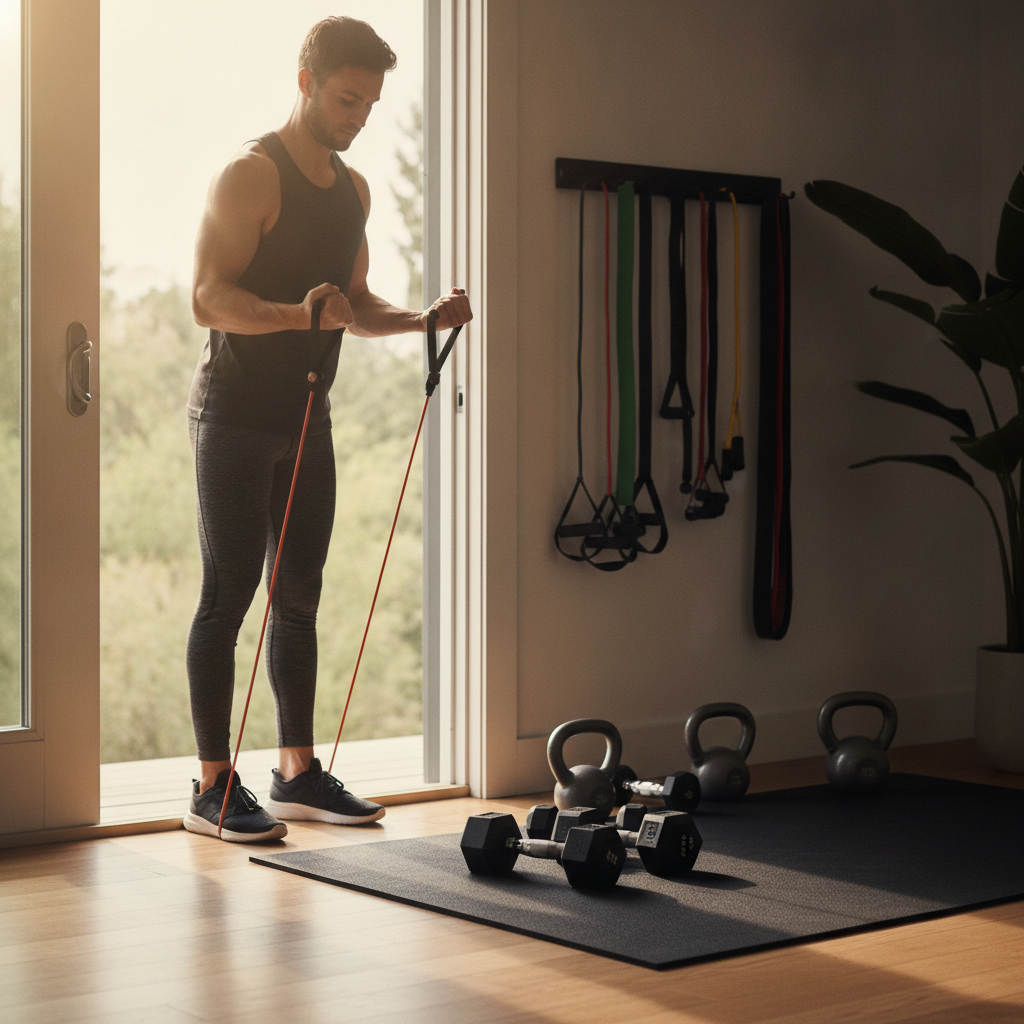
Fitness culture has long equated serious training with heavy iron — the clank of dumbbells, the loaded barbell, the satisfying thud of weight plates stacking up. For decades, free weights set the standard for what a real workout looked like. But that framing has quietly begun to shift, and resistance bands have moved from the periphery of gym culture to something more central, more respected, and increasingly, more preferred by people who train with intention rather than habit.
Rethinking What Resistance Actually Means
The word *resistance* in strength training refers to any force that challenges a muscle to work harder than it would at rest. Free weights achieve this through gravity — a fixed, downward pull that the body must overcome. Resistance bands, by contrast, create tension through elastic deformation, meaning the force they generate changes as the band stretches. This is sometimes called *accommodating resistance*, a concept long used in elite athletic training programs and powerlifting facilities like Westside Barbell in Columbus, Ohio. When a band is fully stretched, it offers peak tension at exactly the moment when many muscles are at their strongest — a relationship that gravity-based tools simply cannot replicate in the same way.
This mechanical difference matters more than most casual gym-goers realize. It means that the muscle is being challenged across a fuller arc of motion, rather than benefiting from momentum or a mechanical advantage at certain joint angles. The practical result is that muscles work harder for longer during each repetition, which translates to meaningful stimulus without necessarily requiring heavy loads.
The Portability Factor Changes Everything
One of the most underappreciated aspects of resistance bands is what they make possible in terms of consistency. Consistency, not intensity, is the most reliable predictor of long-term fitness outcomes — and bands make showing up far easier. A complete set of loop bands or handled bands from brands like TheraBand, Rogue Fitness, or Serious Steel weighs almost nothing and compresses into a small bag. That means a traveler in a hotel room in Lisbon and a person with a fifteen-minute window before work share equal access to a full-body training session.
Free weights require infrastructure. A rack, a bench, a dedicated space, and often a gym membership. Bands require none of that. For people navigating demanding schedules, small apartments, or irregular routines, this is not a minor convenience — it's the difference between training consistently and not training at all. The best workout tool is the one someone will actually use, and on that measure, bands win with very little competition.
How Bands and Free Weights Work Together
Using resistance bands alongside free weights is where many experienced lifters find the most compelling results. The combination allows for what's sometimes called *variable load training* — matching the challenge to the strength curve of each movement. Adding a looped band around a barbell during a squat or bench press, for example, increases tension at the top of the movement where the lifter is typically strongest, removing the easy portion of the lift and demanding more from the muscles throughout.
Bands also shine as accessory tools. Hip circle bands used during warm-ups activate glute medius fibers that often go quiet during heavy compound lifts. Pull-apart exercises with a light band open the chest and strengthen the rear deltoids in ways that pressing-focused programs tend to neglect. Trainers at facilities like Equinox and OPEX gyms have folded band work into their programming not as a beginner concession but as a deliberate technique for building structural balance and reducing injury risk over long training careers.
When Bands Make More Sense Than Free Weights
For certain populations and goals, bands aren't just a supplement to free weights — they're the better primary tool. People recovering from joint injuries often find that bands allow continued training without the compressive forces that free weights place on knees, shoulders, and wrists. The elastic nature of bands provides a degree of forgiveness that metal plates simply don't. Physical therapists and sports medicine practitioners regularly use resistance bands as rehabilitation tools precisely because they load the muscle without stressing vulnerable structures in the same way.
Older adults, beginners, and people returning to training after long breaks often find the psychological and physical entry point of band training far more manageable. There's no learning curve around safely loading and unloading weights, no risk of dropping something heavy, and no requirement to understand barbell mechanics before starting. Progress is still measurable — lighter bands to heavier ones, or increasing repetitions and range of motion — but the barriers are lower, which matters enormously for long-term adherence.
Building a Meaningful Band Practice
If you're ready to take bands seriously rather than treating them as an afterthought, the approach matters. Start by investing in a quality set that covers a meaningful range of resistance — typically a light, medium, and heavy loop band, plus one or two handled bands for pulling movements. Brands like Perform Better and EliteFTS offer well-made options that hold tension without fraying over time.
Structure your sessions the same way you would with free weights: warm-up, primary movements, accessory work, and a brief cool-down. Squats, hip hinges, rows, presses, and carries all translate directly to band versions. Track your progress not by weight lifted but by band tension, repetition quality, and the ability to maintain control through the full range of motion. That last point — control — is where band training often reveals weaknesses that heavy free weight work masks through momentum. Slowing down a band pull or press, pausing at peak contraction, and returning with intention teaches muscular control that transfers back to barbell and dumbbell work with notable effect.
Resistance bands arrived in most people's awareness as a beginner's tool or a rehabilitation prop. That reputation has always sold them short. The elastic resistance they provide is not a lesser version of iron resistance — it's a different kind, with its own advantages, its own applications, and its own capacity to build real strength and lasting physical health. Whether used alongside a full free weight program or as the primary method of training, bands offer something worth taking seriously: a flexible, joint-friendly, always-accessible path to a body that moves well and stays strong. Starting with just one or two bands and one honest session a week is enough to feel the difference.