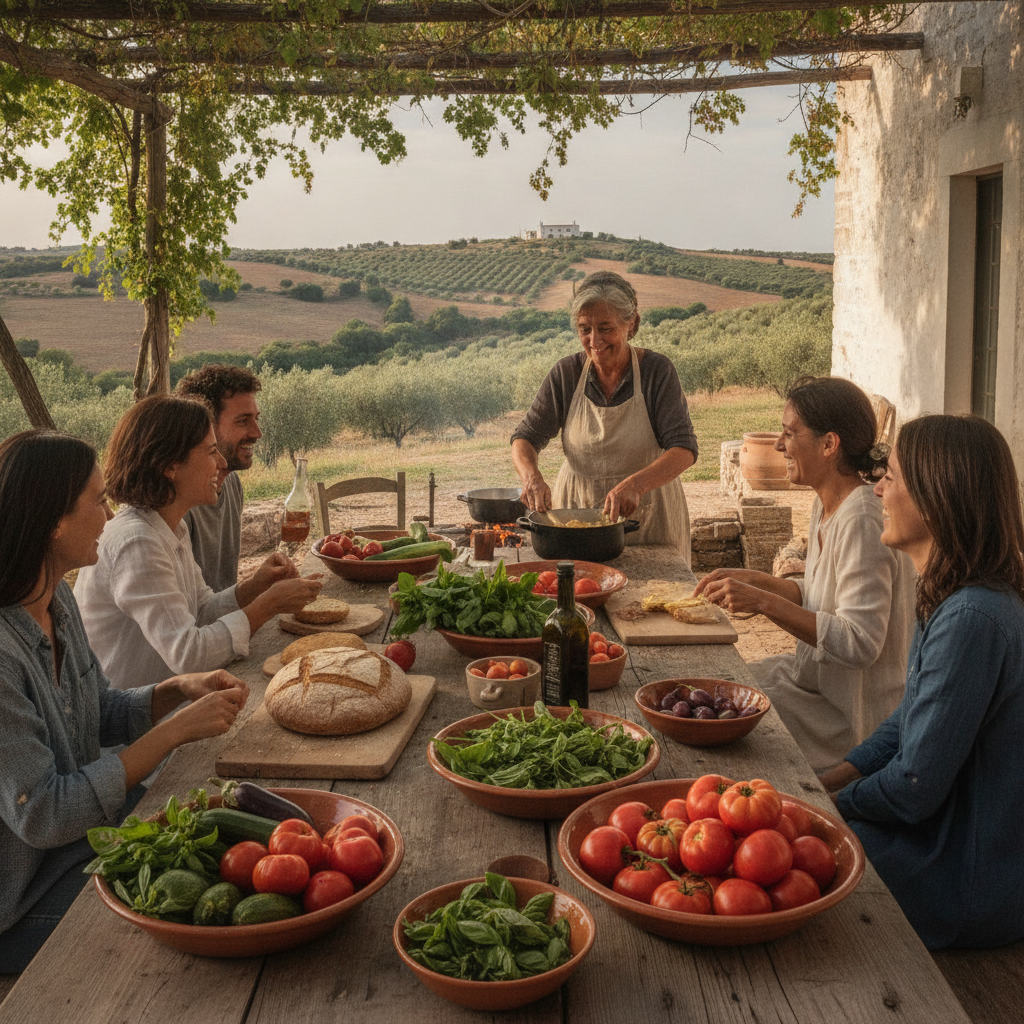
There is a particular kind of meal that changes the way a person thinks about food — not because of what was served, but because of everything surrounding the act of eating it. The table was long, the evening unhurried, the wine drawn from barrels in a basement that smelled of earth and oak. Somewhere between the first course and the third, it became clear that this experience had almost nothing to do with a restaurant and almost everything to do with a way of life that most modern travelers pass through too quickly to fully understand.
What an Agriturismo Actually Is
The word *agriturismo* — from the Italian *agricoltura* (agriculture) and *turismo* (tourism) — describes a legally defined category of rural accommodation in Italy where working farms host paying guests. These are not boutique hotels dressed in linen and rusticity for effect. An agriturismo is required to derive a significant portion of its income from actual farming activity, which means the food on the table, the olive oil in the ceramic cruet, and the wine in the unlabeled bottle are almost always products of the land the traveler is sitting on. In regions like Basilicata, Puglia, and Calabria — the southern territories still relatively undiscovered by mass tourism — this arrangement produces something quietly extraordinary. The guest does not merely visit a place; they inhabit a working agricultural rhythm, however briefly.
Properties like Masseria Il Frantoio near Ostuni in Puglia or the farm stays scattered through the Pollino National Park in Basilicata represent this tradition at its most intact. The host families often work the same land their grandparents cultivated, and the meals they serve trace a culinary lineage that no urban kitchen — however talented its chef — can honestly claim to replicate.
The Philosophy of Slow Food at Its Source
The *Slow Food* movement, founded in 1989 in the small Piedmontese town of Bra by Carlo Petrini, began as a protest against the opening of a McDonald's near the Spanish Steps in Rome. Its founding manifesto called for a right to pleasure, a defense of regional food traditions, and a rejection of the standardization that industrial food culture was accelerating. What the movement articulated in political terms, the rural agriturismo had been practicing without a name for generations. The connection between the two is not coincidental — both rest on the understanding that food divorced from its origin loses something essential.
In a southern Italian farmhouse kitchen, that philosophy is structural rather than ideological. When a host serves *orecchiette con cime di rapa* — the small ear-shaped pasta with bitter turnip greens that is a cornerstone of Pugliese cooking — the ingredients have not traveled far. The greens may have been cut that morning from a garden visible through the kitchen window. The pasta was likely shaped by hand using a technique passed down through women in the family, a form of embodied knowledge that no culinary school captures fully. The dish costs almost nothing to produce and takes patience to prepare. These are precisely the qualities that disappear when the same recipe is reconstructed in a city.
Why Distance Changes Everything
City restaurants, even exceptional ones, operate within constraints that are invisible to the diner but fundamental to the food. Supply chains require standardization. Consistency demands ingredients that behave predictably across seasons and suppliers. A restaurant in Naples or Rome serving cucina povera — literally "poor cooking," the resourceful peasant food of the south — is making an honorable attempt at translation, but translation is what it remains. The original language belongs to places where the cook and the farmer are the same person, or members of the same household.
The agriturismi of southern Italy collapse that distance entirely. When a guest at a farm near Matera in Basilicata eats *pane di Matera* — the protected sourdough bread with its thick crust and golden crumb — baked in the same wood-fired oven that heats the farmhouse, they are eating something irreproducible. The starter culture in that bread may be decades old. The wheat may be *Senatore Cappelli*, an ancient durum variety that thrives in the stony soils of the mezzogiorno and was all but abandoned during the green revolution before being revived by Slow Food-affiliated farmers in the late twentieth century. No city bakery, however artisanal, can make that bread, because the bread is inseparable from that specific soil, water, and history.
The Table as Social Architecture
Perhaps the most disorienting realization for visitors who have spent most of their food lives in restaurants is that the agriturismo meal is not a transaction. There is no menu in the conventional sense. The host decides what is served based on what the season offers and what the farm has produced. Guests eat together, often at communal tables, with strangers who become, by the second course, something closer to temporary family. The *tavolata* — the long shared table — is not a design choice. It is the inherited social form of agricultural communities where eating together was both practical necessity and cultural ritual.
This architecture of the meal produces a relationship to food that is fundamentally different from restaurant dining, where individual choice and private experience are the defaults. At a farmhouse table in the Cilento coast region south of Salerno — an area recognized by UNESCO for its relationship to the Mediterranean diet — the meal stretches across hours not because service is slow, but because unhurried eating is the point. The *convivio*, the shared meal as communal pleasure, is the thing itself, not the backdrop to it.
What You Carry Back
For the traveler willing to leave the cities for a few nights, the agriturismo offers something that cannot be purchased or packaged: a recalibration of expectations about what food is for. Spending time at a working farm in Puglia, Basilicata, or Calabria makes the industrial food system feel not merely inadequate but faintly absurd. The guest who arrived thinking of dinner as a cultural experience leaves understanding that, in these places, dinner is culture — the living expression of a relationship between people, land, and time that city life has largely dismantled.
That recalibration tends to be durable. The traveler who sat at a long table in a stone farmhouse as the sun dropped behind an olive grove and ate seven courses they did not order, drank wine they cannot find at home, and spent three hours in conversation with strangers — that traveler returns to urban restaurants with a new and quietly inconvenient awareness. The food may be excellent. But something is missing, and now they know what it is.