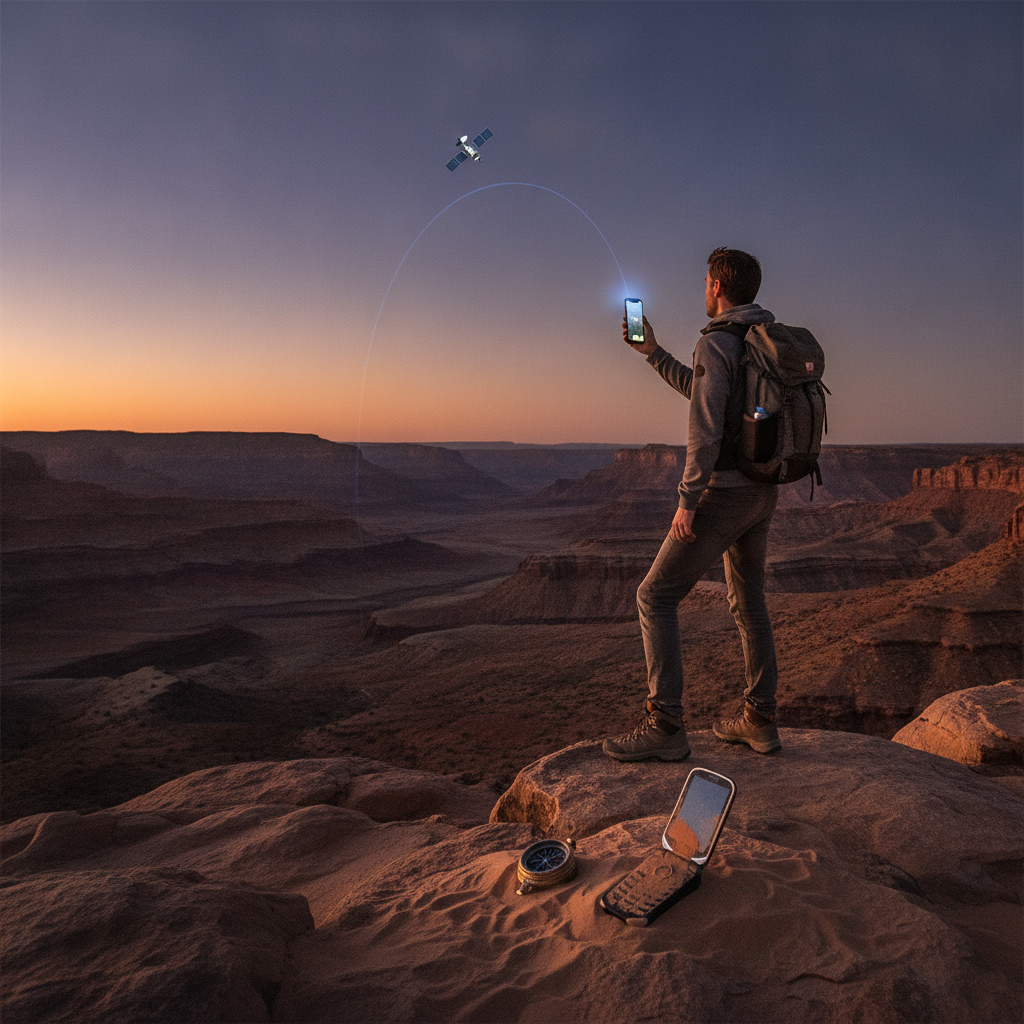
The concept of being truly unreachable has quietly been disappearing from modern life. For decades, stepping beyond the reach of a cellular tower meant cutting off access to emergency services, navigation, and communication simultaneously. Satellite connectivity built directly into consumer smartphones is changing that reality in ways that matter far beyond adventure sports or remote travel — it affects how people think about safety, preparedness, and the boundaries of everyday experience.
When the Signal Bar Finally Hit Zero
For most of the smartphone era, dead zones were simply accepted as an inevitable limitation. Mountain trails, open ocean crossings, rural highways, and vast stretches of desert all shared one defining characteristic: once a person moved beyond cell coverage, they were on their own. The solution, historically, was to carry separate satellite communicators from brands like Garmin or SPOT alongside a regular phone. That two-device reality was inconvenient, expensive, and largely ignored by the general public — people who didn't consider themselves outdoors enthusiasts rarely thought about the gap until they were already in it.
How Manufacturers Built Satellite Into Everyday Devices
Apple was the first major consumer electronics company to bring satellite messaging to a mainstream smartphone with the iPhone 14 in 2022. The feature allowed users to send compressed emergency messages through satellite networks when no cellular or Wi-Fi signal was available. Since then, the technology has matured considerably. Qualcomm's Snapdragon platforms have made satellite connectivity available to Android device manufacturers, and Google integrated the capability into Pixel hardware as well. The hardware challenge was significant — satellite signals are far weaker than cellular signals, requiring sophisticated antenna design and software that can compress a message to fit narrow bandwidth constraints. Manufacturers solved this without meaningfully increasing device size, which accelerated consumer adoption.
What the Technology Can and Cannot Do
Satellite connectivity in smartphones currently operates within specific boundaries that are worth understanding clearly. Most implementations are designed for emergency SOS messaging and basic location sharing rather than streaming, browsing, or voice calls. Sending a message may take anywhere from several seconds to a few minutes depending on satellite position and atmospheric conditions. The systems work by connecting to low-Earth orbit satellite networks, which offer lower latency than older geostationary systems but still cannot match the responsiveness of a cellular connection. Starlink's direct-to-cell service represents the next evolution — it aims to deliver standard text messaging and, eventually, data access to unmodified devices — but that capability remains in early deployment phases and is not yet universally available to consumers.
The Safety Shift for Casual and Serious Travelers Alike
The implications extend well beyond hikers and mountaineers. A family driving through rural Wyoming, a sailor anchored off the coast of Newfoundland, or a traveler whose rental car breaks down on an unmarked road in Sardinia all face the same fundamental problem when cellular service disappears. Satellite-enabled smartphones offer a meaningful safety net in each of those situations. Emergency responders have noted that satellite SOS features reduce rescue delays in wilderness incidents because distressed individuals can communicate location data more precisely than in previous years. The psychological effect is real as well — knowing a phone can reach emergency services outside of coverage changes how people approach trips that would otherwise require careful contingency planning.
How Connectivity Expectations Are Shifting
As satellite messaging becomes a standard feature rather than a premium add-on, consumer expectations are evolving alongside the technology. Buyers increasingly treat satellite connectivity as a baseline safety expectation rather than a differentiating feature, similar to how water resistance shifted from a luxury specification to a standard requirement over the past decade. This expectation is already influencing how telecommunications companies market coverage. Carriers are under growing pressure to clarify exactly where their networks end and where satellite features begin, particularly as Starlink and competing services blur the line between satellite and cellular. The broader question emerging in the industry is whether hybrid connectivity — seamlessly switching between cellular towers and satellite networks without user intervention — will define the smartphone standard within the next few years.
What to Know Before Relying on It
If you own a recent iPhone, Pixel, or another satellite-capable device, understanding how to activate the emergency feature before you actually need it is worth the few minutes it takes. Apple's Emergency SOS via satellite, for example, requires clear sky visibility and works best when you follow the on-screen prompts pointing the phone toward a satellite. Testing the feature in non-emergency mode — Apple offers a demo function — builds familiarity so the process feels less unfamiliar in a stressful situation. Keeping your phone charged before entering remote areas remains essential, since satellite transmissions draw more power than standard cellular communication. Checking whether your carrier or device plan includes satellite access at no additional cost is also practical, as billing structures vary and some providers still treat the feature as an add-on service.
Satellite connectivity in smartphones is not a finished product — it's a rapidly developing capability that will look significantly different within a few years. As low-Earth orbit networks grow denser and direct-to-cell data services expand, the distinction between connected and disconnected will continue to blur. The more important shift may be cultural: the assumption that going somewhere remote means accepting total isolation is giving way to a more nuanced understanding of what a phone can do when the last tower disappears in the rearview mirror.