Ground transport in Morocco is less a method of getting from place to place than it is the experience itself. The country's trains, shared taxis, and long-distance buses don't merely connect cities — they open corridors into a version of Morocco that organized tours, with their air-conditioned coaches and pre-negotiated itineraries, rarely pause long enough to notice. The traveler who boards a CTM bus in Marrakech at dawn and rides it south toward Agadir through the pre-Atlas foothills is not simply saving money or covering distance; they are entering a social world that operates entirely on its own terms, shaped by ritual, patience, and an unhurried sense of collective belonging.
The Rhythms of the Grand Taxi
Few forms of transport in the world say as much about a country's social architecture as the Moroccan grand taxi. These are typically aging Mercedes sedans, licensed to carry six passengers — two in front beside the driver, four compressed into the back — and they depart only when every seat is filled. The wait can be ten minutes or an hour, depending on the route and the time of day, and that waiting is itself instructive. Passengers share cigarettes, exchange news, shift their bags to accommodate newcomers, and engage in the kind of unhurried small talk that defines daily life outside the tourist circuit. Between cities like Chefchaouen and Ouezzane, or Essaouira and Safi, the grand taxi is the connective tissue of ordinary Moroccan movement, and riding one means, briefly, becoming part of that tissue rather than a spectator to it.
What the Train Between Fes and Casablanca Carries
ONCF, the national rail operator, runs a network that threads through Morocco's most populated corridor, and the trains themselves are a cross-section of contemporary Moroccan life that no guided tour replicates. Second-class carriages on routes like Fes to Casablanca fill with students heading home for the weekend, civil servants with document folders on their laps, and women carrying woven bags packed with food from the medina markets. Conversations in Darija — the Moroccan dialect of Arabic, dense with French and Amazigh loanwords — flow across compartments with casual ease. The train's rhythm slows at Meknes, Sidi Kacem, Kenitra, each stop peeling off one layer of passengers and adding another, and by the time Casablanca's Gare de Voyageurs comes into view, a traveler paying attention will have absorbed more about the country's social textures than most guidebooks manage to capture in full chapters.
Roadside Morocco and the Geography of the In-Between
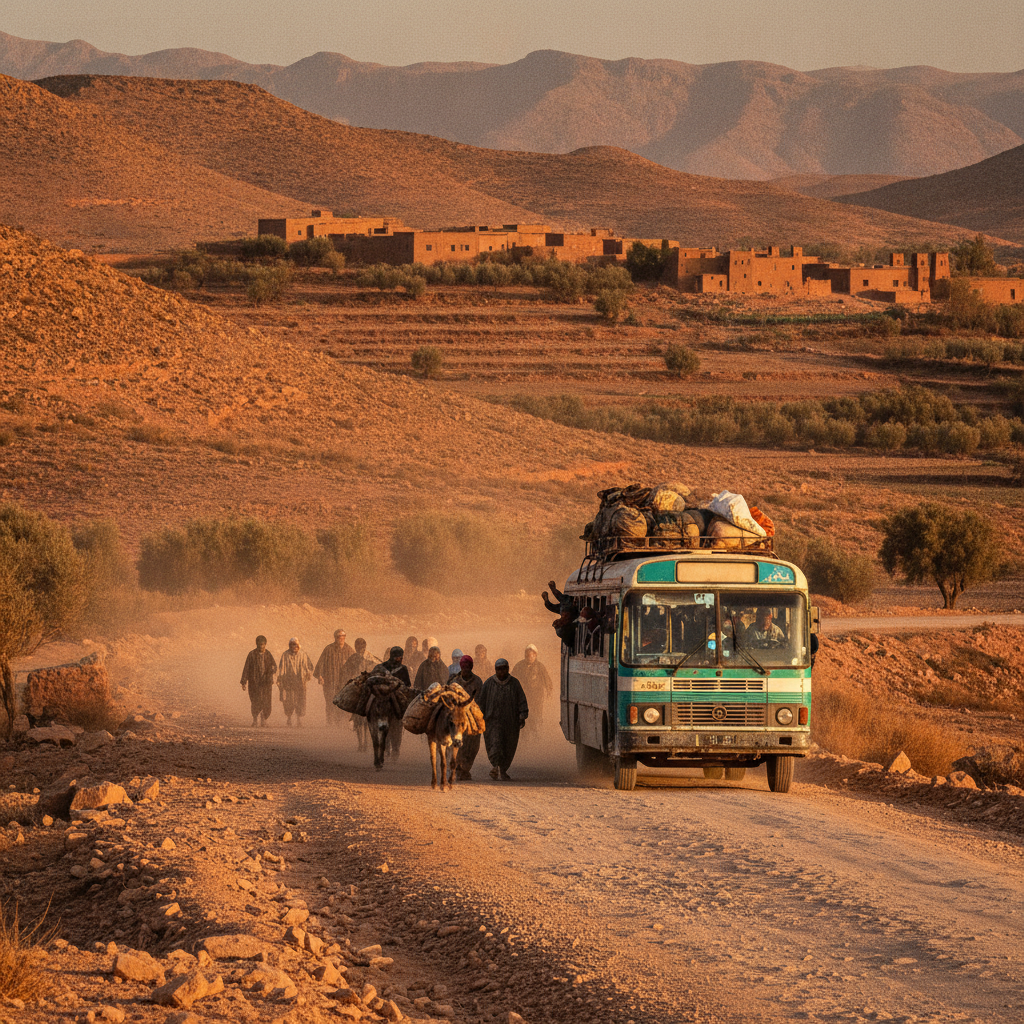
Bus travel through southern Morocco reveals a geography that aerial views and highlight reels routinely flatten into abstraction. The stretch between Ouarzazate and Zagora, for instance, passes through landscapes that shift from sparse argan woodland to dust-colored plains to the faint green edges of oasis settlements, all within a few hours. What the bus window offers that organized excursions rarely do is time — time to notice the roadside mechanics working under makeshift shade structures, the women in bright djellabas walking along road shoulders with purpose, the small towns built around a single functioning café and a gas station that doubles as a community hub. These places are not destinations in any tourism-industry sense, but they are Morocco in its most unperformed form, and ground transport passes directly through them rather than around them.
Language, Negotiation, and Cultural Contact
Traveling by shared transport in Morocco requires and rewards a willingness to engage with the country's layered linguistic reality. Standard Arabic, French, Darija, and Tamazight — the language of the indigenous Amazigh people, now an official language alongside Arabic — all surface in different contexts and combinations depending on region and company. A traveler working through the logistics of a grand taxi fare in broken French, or asking about bus schedules in a mix of Arabic phrases and gestures, is participating in exactly the kind of cross-cultural exchange that packaged tours eliminate in the name of comfort. The negotiation itself, the small friction of figuring out where the bus stops and whether the seat is confirmed and what the attendant at the window actually means, produces a familiarity with the country's daily texture that smooth, pre-arranged itineraries cannot manufacture.
What Slows Down Reveals
When you choose to move through Morocco the way most Moroccans move — waiting, boarding, shifting, arriving not quite on schedule but arriving nonetheless — the country's relationship with time becomes legible in a way that no cultural briefing quite explains. The concept of baraka, a kind of blessed ease or grace that permeates religious and daily life, has a ground-level expression in the way delays are absorbed without anxiety, in the way fellow passengers offer food during long journeys without being asked, in the way a driver stops the grand taxi so an elderly woman can cross a rural road at her own pace. These are not quaint observations for a travel diary. They are the country's operating values made visible, and they surface most naturally when a traveler's own pace slows enough to match them. The medinas of Fes and Marrakech will always be remarkable, but the road between them, traveled slowly and cheaply, carries its own weight of meaning.
The traveler who first arrives in Morocco through a polished group itinerary and later returns to cross the country by bus and shared taxi will recognize the same landscapes and monuments but encounter what feels like a different country entirely — not because the country changed, but because the method of moving through it finally allowed the country to be itself. Ground transport in Morocco doesn't deliver a curated experience. It delivers the unedited version, and that, almost always, turns out to be the more lasting one.