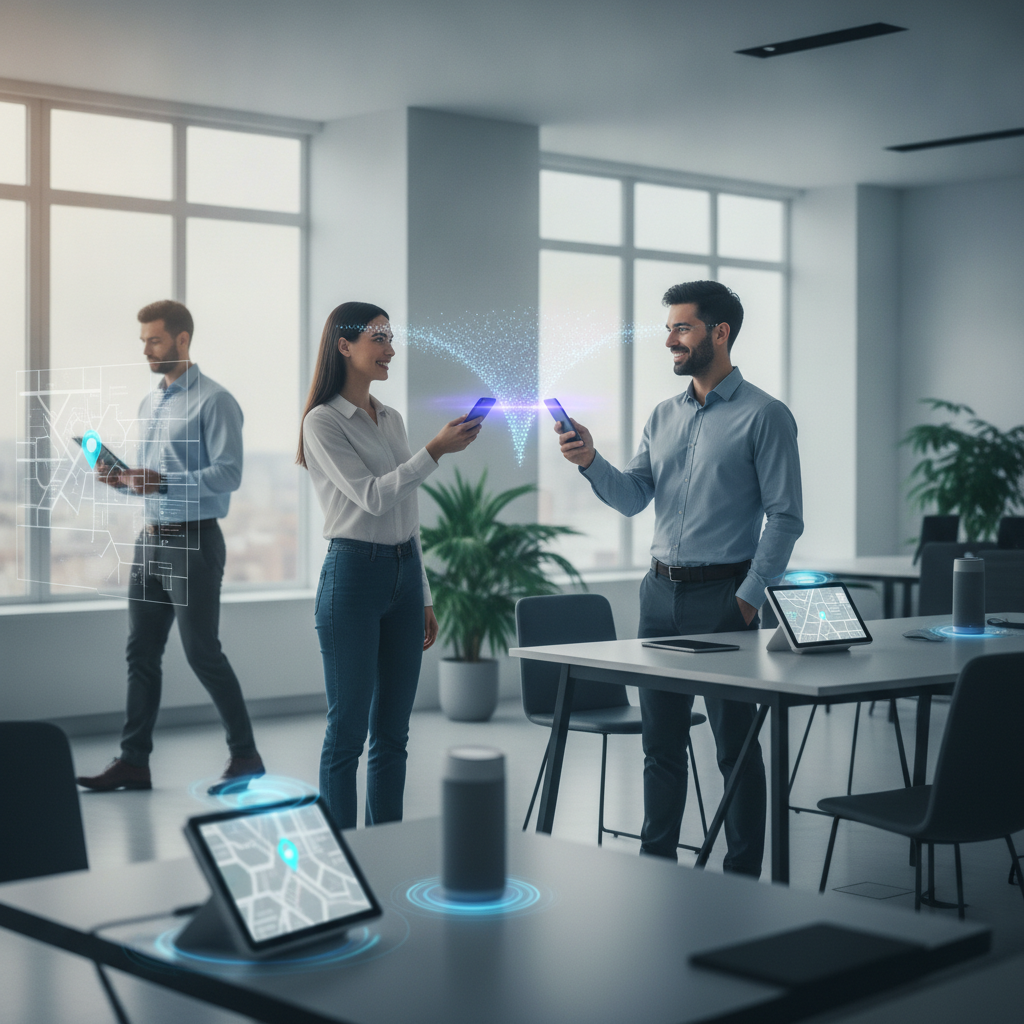
Wireless technology has long promised precision it couldn't quite deliver — but ultrawideband is changing the terms of that promise in ways that are already reshaping everyday smartphone use.
What Ultrawideband Actually Is
Ultrawideband, commonly referred to as UWB, is a short-range wireless communication protocol that transmits data across an extremely wide frequency spectrum at low power. Unlike Bluetooth or Wi-Fi, which estimate proximity through signal strength, UWB calculates precise distance and direction by measuring the exact time it takes radio pulses to travel between devices. This time-of-flight method allows for spatial accuracy down to centimeters rather than meters. Apple introduced UWB in the iPhone 11 through its U1 chip, and Samsung followed with similar hardware in several Galaxy models, bringing the technology to hundreds of millions of consumer devices.
Why Indoor Navigation Has Always Been a Problem
GPS is remarkably effective outdoors, but it struggles dramatically the moment a person steps inside a building. Satellite signals weaken as they pass through concrete, glass, and steel, making floor-level accuracy nearly impossible inside hospitals, airports, or shopping centers. Alternative approaches using Bluetooth beacons or Wi-Fi triangulation have filled some of that gap, but they're plagued by environmental interference and inconsistent results. A shopper searching for a specific department inside a large IKEA store, or a patient trying to locate an unfamiliar clinic inside a hospital complex, quickly discovers how unreliable conventional indoor location tools really are. UWB directly addresses this limitation by working independently of satellite signals.
How UWB Changes Spatial Precision Indoors
Because UWB calculates position using pulse timing rather than signal strength, it remains accurate in cluttered environments where walls, furniture, and crowds scatter traditional radio signals. Devices equipped with UWB can pinpoint each other's location within roughly ten centimeters, and when multiple UWB anchor points are installed throughout a building, they create a mesh of reference coordinates that a smartphone can use to determine its exact position in three dimensions. Boingo Wireless and several major airport operators have begun testing UWB infrastructure for real-time wayfinding in terminal buildings. The technology can also detect whether a device is in front of, behind, or to the side of another — a directional capability Bluetooth simply doesn't offer.
Device Sharing Gets a Meaningful Upgrade
Beyond navigation, UWB is making peer-to-peer device interaction far more intentional and reliable. Apple's AirDrop, when operating on UWB-equipped devices, uses spatial awareness to prioritize the correct recipient in a crowded room — a meaningful improvement over earlier versions that struggled to target the right person when several iPhones were nearby. Samsung's Nearby Share and SmartThings platform have incorporated UWB in similar ways, allowing users to point their phones at a specific speaker, television, or smart appliance and trigger controls contextually. The act of physically pointing at a device to interact with it sounds simple, but it requires the kind of centimeter-level accuracy that only UWB currently provides at consumer scale.
Real-World Applications Already in Motion
Several industries are moving UWB from pilot programs into standard infrastructure. Automotive manufacturers including BMW and Volkswagen have adopted UWB for digital car keys, replacing proximity-based key fobs with a system that knows precisely where the driver is standing relative to the vehicle — reducing the relay-attack vulnerabilities that plagued older passive entry systems. Retailers are exploring UWB-enabled shopping carts that guide customers through store layouts with turn-by-turn directions. Hospitals are using UWB asset tracking to locate medical equipment in real time without staff manually searching storage rooms. Each of these applications depends on the same core capability: knowing not just that something is nearby, but exactly where it is.
What This Means for Your Daily Smartphone Experience
For practical purposes, you don't need to understand the physics of pulse timing to benefit from UWB — but knowing it's there helps explain some features that may already feel different on newer devices. If you use AirDrop frequently, pointing your phone toward the intended recipient rather than waiting for a list to populate is now both faster and more accurate. If your car supports a digital key, the experience of walking up and having the door unlock without fumbling for your phone is a direct result of UWB working behind the scenes. When navigating a large venue that has deployed UWB anchors, your maps app can display real-time position updates inside the building with a reliability that feels closer to outdoor GPS than anything available before. Keeping your phone's software updated ensures you're receiving ongoing optimizations to these UWB-dependent features as manufacturers refine their implementations.
Ultrawideband is still in a relatively early phase of infrastructure deployment, but the hardware is already in millions of pockets. As buildings, vehicles, and consumer electronics add UWB anchor points and compatible chips, the gap between what the technology can do in controlled tests and what people experience daily will continue to close. The most significant changes — seamless indoor wayfinding, context-aware device sharing, and environment-aware smart home control — are not distant possibilities. They are already arriving, quietly and steadily, with each new generation of devices and the spaces designed to work alongside them.