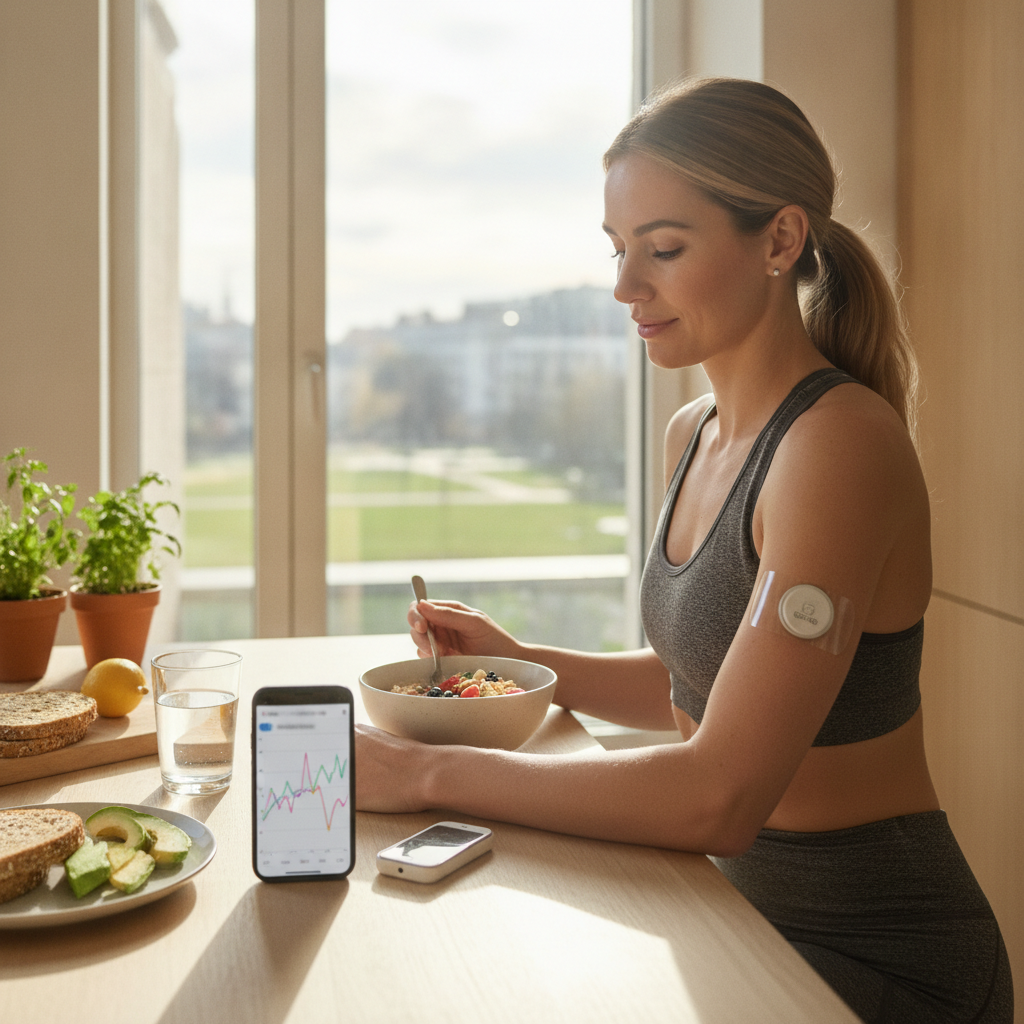
There is a quiet frustration that many health-conscious people share: eating what seems like a reasonable diet, exercising regularly, and still feeling inexplicably tired, foggy, or hungry at odd hours. The body gives signals, but the language feels impossible to decode without some kind of translator. In recent years, a small wearable device — originally developed for people managing diabetes — has started filling that role for a much broader audience.
What Does a Continuous Glucose Monitor Actually Measure?
A continuous glucose monitor, or CGM, is a small sensor worn on the upper arm or abdomen that tracks blood sugar levels in real time, typically updating every few minutes throughout the day and night. Devices like the Abbott Freestyle Libre and Dexcom G7 were designed to help people with Type 1 and Type 2 diabetes avoid dangerous blood sugar swings. They work by reading glucose levels in the fluid just beneath the skin and transmitting that data wirelessly to a smartphone app. The readings create a continuous curve rather than a single snapshot, which is what makes them so revealing. A fasting blood test tells you where you are at one moment; a CGM tells you the whole story of how your body responds to food, stress, sleep, and movement over days or weeks.
For people without diabetes, blood sugar generally stays within a narrower range, but that doesn't mean the fluctuations are meaningless. Research in metabolic health has made clear that the *pattern* of glucose response — how high it spikes, how quickly it falls, how long it stays elevated — has real implications for energy levels, hunger, mood, and long-term metabolic function.
Why Non-Diabetics Are Paying Attention
The interest among non-diabetic users has been building steadily. Companies like Levels Health, which pairs CGM data with a dedicated coaching app, have positioned themselves specifically for people who want metabolic insight without having a diagnosis. The appeal is straightforward: rather than relying on general dietary advice, a person can observe directly how their own body responds to a bowl of white rice versus brown rice, or how a night of poor sleep shifts their morning glucose baseline.
This kind of personalized data feels different from a food journal or a calorie counter. It removes some of the guesswork. Someone who has always assumed oats were a stable breakfast food might be surprised to find their glucose spikes sharply within thirty minutes, then drops just as quickly — leaving them hungry again by mid-morning. Another person might find that the same oats cause barely any fluctuation at all. Individual variation in glucose response, something researchers call *glycemic variability*, turns out to be quite significant even among people eating identical meals.
How the Data Connects to Energy and Focus
One of the most consistent observations among non-diabetic CGM users is the link between post-meal glucose crashes and afternoon fatigue. The experience many people describe as a "3 PM slump" often corresponds to a rapid rise and fall in blood sugar following a high-carbohydrate lunch. When glucose drops sharply after a spike — a pattern sometimes called reactive hypoglycemia in mild form — the body reads it as a low-fuel signal, triggering hunger hormones, reduced concentration, and a desire to rest or reach for something sweet.
Seeing this pattern on a graph can be surprisingly motivating. Instead of blaming willpower for an afternoon snack craving, a person can understand it as a predictable physiological response and experiment with meal composition — adding more protein, fat, or fiber — to flatten that curve. Apps connected to CGM devices often display these patterns visually, making it easier to connect the dots between what was eaten and how the body felt two hours later.
The Cultural Shift Toward Metabolic Awareness
This movement sits within a broader cultural conversation about *biohacking* — a term borrowed from Silicon Valley that refers to the practice of using data and self-experimentation to optimize health and performance. While the word can carry connotations of extreme measures, the CGM trend represents a relatively accessible version of that impulse. Wearing a glucose sensor for two or four weeks doesn't require medical supervision for most healthy adults, and the cost, while not trivial, has come down considerably as the technology has matured.
In wellness communities, particularly in cities like Austin and Los Angeles, CGM use among non-diabetics has become almost a standard conversation topic among people interested in longevity and performance. Functional medicine practitioners increasingly recommend short-term CGM trials as a diagnostic tool for understanding a patient's metabolic baseline before designing a nutrition plan.
What to Keep in Mind Before You Try One
If you're considering using a CGM without a diabetes diagnosis, a few things are worth understanding before you start. Glucose data is rich, but it can also be misread without context. A spike is not automatically a problem — exercise, stress, and even a strong cup of coffee can all temporarily shift glucose levels in ways that look dramatic on a graph but are entirely normal. The goal isn't to eliminate all glucose fluctuation; it's to understand your personal patterns and identify changes worth making.
It's also worth noting that CGMs are a tool for insight, not a prescription. What the data reveals should ideally be discussed with a healthcare provider, particularly if you notice patterns that seem unusual — very high fasting levels, frequent sharp drops, or readings that don't match how you feel. The information is most useful when it becomes part of a larger conversation about health rather than an end in itself.
The original frustration — that sense of doing everything right and still feeling off — is rarely answered by a single device. But for many people, seeing their own metabolic patterns in real time has been the missing piece that finally made their diet and energy make sense. The body was always communicating; the CGM just made it easier to listen.