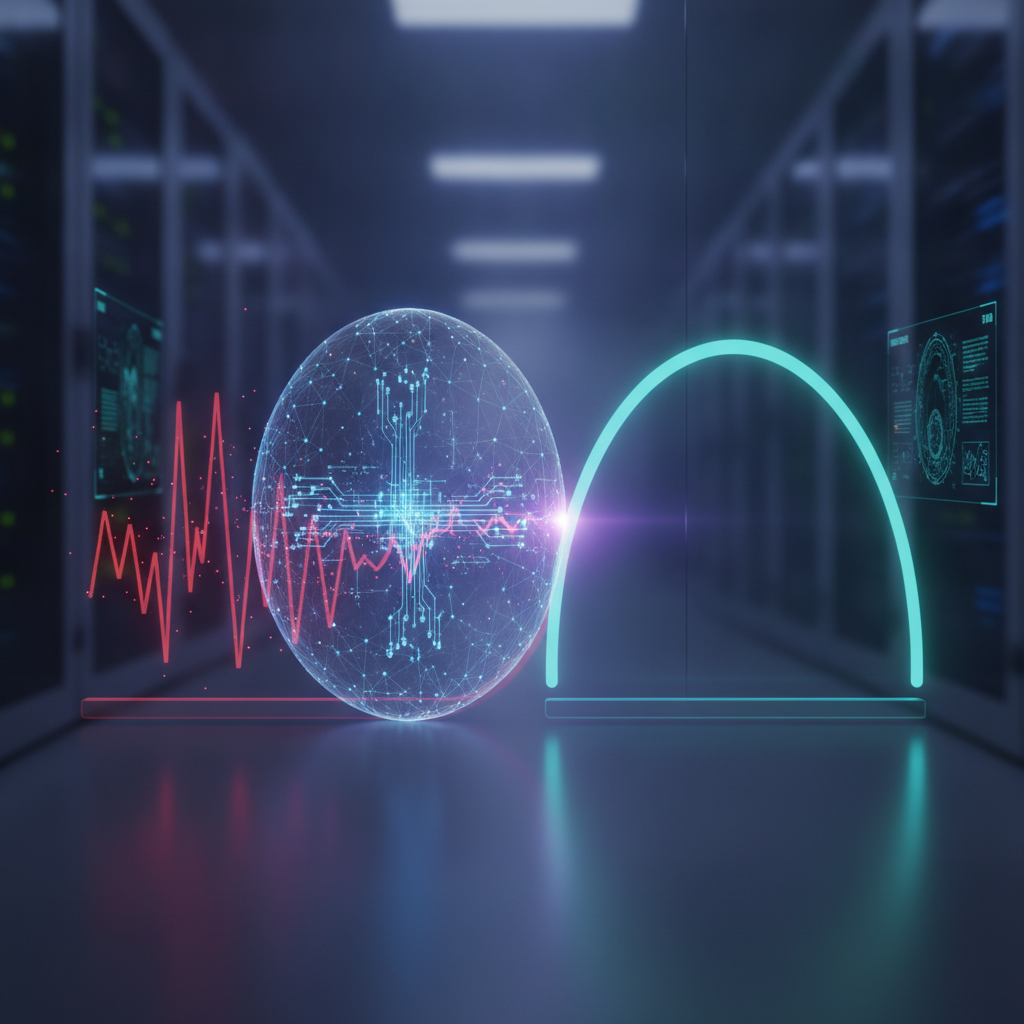
Quantum computing has long existed in a peculiar space — powerful in theory, fragile in practice. The machines that researchers have built over the past two decades can perform genuinely remarkable calculations, yet they remain too unreliable for real-world deployment at scale. The central obstacle is not processing power or chip design in the traditional sense. It is error. Quantum systems are extraordinarily sensitive to their environment, and even minor disturbances cause calculations to collapse before they can deliver useful results. Quantum error correction is the discipline working to solve that problem, and in 2026, it is closer to succeeding than ever before.
The Fragility Problem at the Heart of Quantum Systems
Classical computers store information as bits — values that are either 0 or 1. Quantum computers use qubits, which can exist in superposition, representing both states simultaneously. This property gives quantum machines their computational edge, but it also makes them deeply unstable. Qubits lose their quantum state through a process called decoherence, triggered by heat, electromagnetic interference, or even stray vibrations. Maintaining coherence long enough to complete a meaningful computation requires extraordinary environmental controls, and even then, errors accumulate rapidly. The challenge is not just building qubits — it is keeping them behaving correctly long enough to matter.
What Quantum Error Correction Actually Does
Error correction in quantum computing cannot work the same way it does in classical systems. In classical computing, a corrupted bit can simply be checked against a backup copy. Quantum mechanics prohibits directly copying a qubit's state — a constraint known as the no-cloning theorem. Instead, quantum error correction encodes the information from a single logical qubit across many physical qubits, distributing it in a way that allows errors to be detected and corrected without ever measuring the underlying quantum state directly. The system observes relationships between qubits rather than the qubits themselves, preserving the fragile superposition while still catching mistakes.
Several error-correcting codes have emerged as leading candidates for practical use. The surface code, developed and refined by teams at Google and IBM among others, arranges physical qubits in a two-dimensional grid and monitors stabilizer measurements to detect bit-flip and phase-flip errors. It requires a large number of physical qubits per logical qubit — estimates range widely depending on error rates — but it is compatible with existing hardware architectures. Microsoft has pursued a different approach, focusing on topological qubits that are inherently more resistant to local errors, reducing the overhead needed for correction. Each strategy reflects a different theory about where the most efficient path to fault-tolerant computing lies.
The Overhead Challenge and Why It Matters
The core tension in quantum error correction is overhead. Encoding one reliable logical qubit currently demands dozens to thousands of physical qubits, depending on the target error rate and the code being used. Today's quantum processors, including Google's Willow chip and IBM's Heron series, contain hundreds to a few thousand physical qubits. That means the number of error-corrected logical qubits available for actual computation remains very small. Scaling to the millions of physical qubits that fault-tolerant quantum computing may ultimately require represents one of the field's most significant engineering challenges. Progress is real, but the gap between demonstration and deployment remains substantial.
Recent Breakthroughs Changing the Calculus
Several developments have meaningfully shifted expectations in recent years. Google's research teams demonstrated that increasing the size of their surface code patches actually reduced logical error rates — a milestone known as achieving below-threshold performance, where more qubits genuinely produce better results rather than just more noise. This was a theoretical requirement for practical error correction, and seeing it confirmed experimentally marked a turning point. IBM has similarly published results showing improved logical qubit lifetimes using their heavy-hexagon code architecture. These are not finished products, but they represent the first clear evidence that the theoretical frameworks for error correction translate into measurable hardware improvements.
Microsoft's approach through its Azure Quantum program has taken a longer-term bet on topological qubits, which use non-Abelian anyons to store information in a way that is physically protected from many common error sources. The company reported early hardware results in 2026 that suggest topological qubits can be manufactured reliably enough to begin error correction experiments. Whether this path converges with or diverges from the surface code approach remains an open question, but the diversity of serious research efforts suggests the field is not locked into a single solution.
What This Means if You Are Watching the Space
If you are tracking quantum computing as a technology investor, enterprise decision-maker, or technically curious observer, the error correction story is the most important signal to follow. Raw qubit counts are a less meaningful benchmark than logical qubit quality and the physical-to-logical qubit ratio a given system achieves. When evaluating announcements from companies like IBM, Google, IonQ, or Quantinuum, look for claims about logical error rates and below-threshold performance rather than headline qubit numbers. The transition from noisy intermediate-scale quantum devices to early fault-tolerant systems will not happen in a single announcement — it will be gradual, measurable, and traceable through the error correction metrics that researchers consider foundational.
Quantum error correction is moving from a theoretical necessity into an engineering discipline with concrete milestones and competitive momentum. The gap between what quantum computers can do in a controlled experiment and what they can reliably deliver in a practical setting is narrowing — not because the hardware is becoming simpler, but because researchers are learning to manage its complexity with increasing sophistication. The next several years will test whether that sophistication can scale, and the answer will determine when quantum computing transitions from a remarkable scientific achievement into a broadly useful computational tool.